
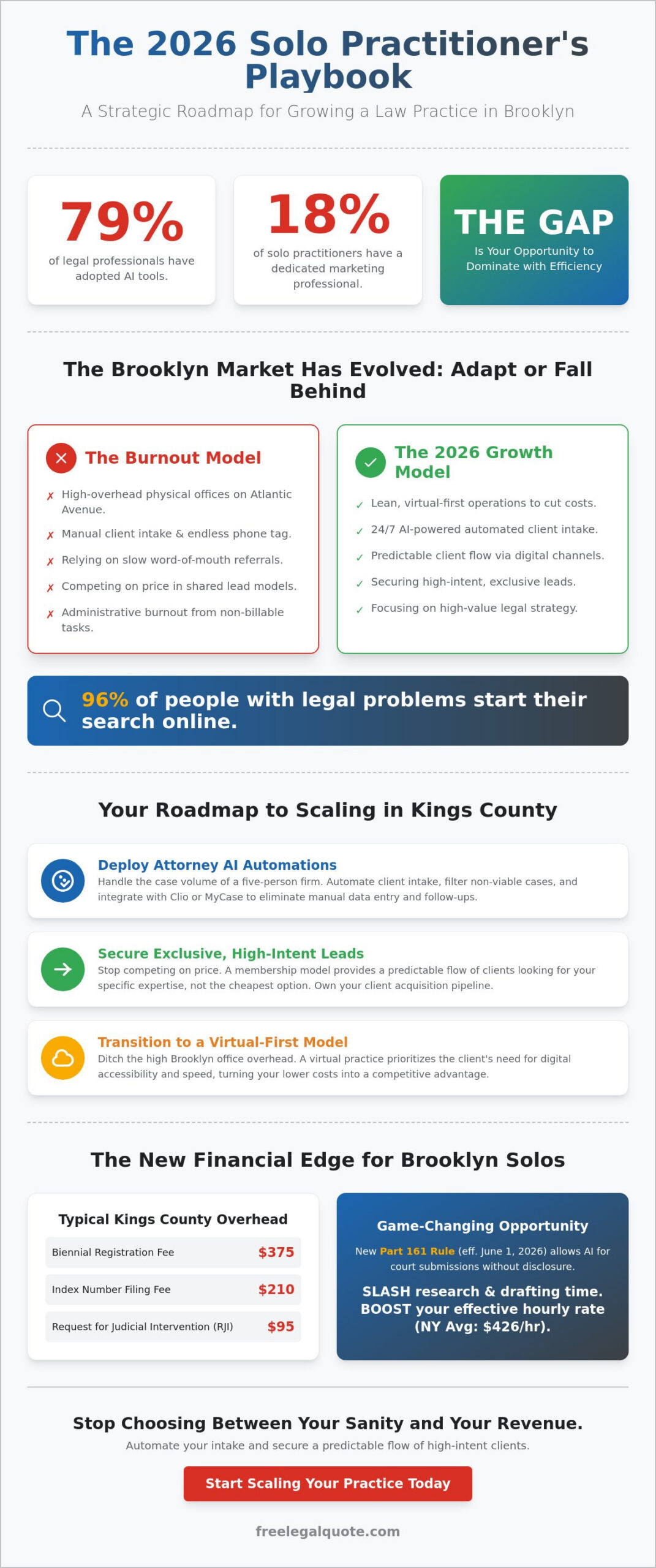
79% of legal professionals have now adopted AI, yet only 18% of solo practitioners have a dedicated marketing professional to help them compete. You’re likely feeling the squeeze of high Brooklyn office overhead and the relentless pace of Kings County Supreme Court. It’s exhausting to manage manual intake while trying to outmaneuver mid-sized firms with deep pockets. You shouldn’t have to choose between your sanity and your revenue growth. This guide shows you exactly how to grow a solo law practice in Brooklyn by turning these local challenges into distinct advantages. We’ll provide a pragmatic roadmap to scaling your practice using AI automation and high-intent lead generation. This approach allows you to act like a mid-sized firm without the massive payroll or administrative burnout. You’ll discover how to secure a predictable monthly client flow while slashing the manual tasks that slow you down. This is your strategy for 2026, designed to protect your interests and your bottom line through efficiency and speed.
Key Takeaways
- Transition from high-overhead physical offices to a virtual-first model to compete effectively in the Kings County market.
- Deploy attorney AI automations to manage client intake and eliminate the administrative burnout of manual phone calls.
- Discover how to grow a solo law practice in Brooklyn by securing exclusive legal leads that avoid the price wars common in shared lead models.
- Leverage a membership subscription to create a sustainable, predictable flow of high-intent clients for your practice.
- Audit your current workflow to identify specific automation opportunities that allow you to scale without adding support staff.
The 2026 Brooklyn Legal Landscape: Navigating Kings County Competition
The days of relying on a prestigious Atlantic Avenue address to win cases are over. In 2026, the Brooklyn legal market is defined by digital speed and virtual efficiency. If you are a solo practitioner in Kings County, you’re facing a crowded field. There are over 12,000 firms across New York, and many are vying for the same high-stakes cases in the Kings County Supreme Court. Relying on old-school word-of-mouth isn’t enough for aggressive growth anymore. 96% of people with legal problems start their search online. They aren’t looking for a mahogany desk. They want immediate answers. Understanding how to grow a solo law practice in Brooklyn means meeting these clients exactly where they are: on their phones, looking for fast, transparent help.
The psychological state of the modern Brooklyn client has shifted. They value accessibility over tradition. They expect a seamless digital experience from the first click to the final resolution. If your intake process involves waiting for a callback, you’ve already lost the lead to a faster competitor. Mastering how to grow a solo law practice in Brooklyn is about leveraging these local nuances to outpace the competition. You must move with the same urgency your clients feel when they seek legal protection.
Brooklyn Market Dynamics and Practice Area Trends
Specialization is your greatest weapon. Whether you’re targeting tech-startups in DUMBO or personal injury cases near the Barclays Center, local expertise beats a general practice every time. You must also manage the rising costs of doing business. Between the $375 biennial registration fee and Kings County filing fees like the $210 index number or $95 RJI, overhead adds up fast. The new Part 161 rule, effective June 1, 2026, allows you to use AI for court submissions without disclosure. This is a massive opportunity to cut research time and stay lean while your competitors are bogged down by manual drafting. Use this regulatory shift to maintain high margins even as New York hourly rates average around $426.
Overcoming the ‘Solo Stigma’ in a Big Firm Borough
Don’t try to look like a massive firm. Try to look like a better one. Position your practice as a boutique alternative that offers the high-touch service big firms can’t match. Use these strategies to build immediate trust:
- Transparency: Use clear, risk-free language to dismantle barriers to entry.
- Accessibility: Offer digital intake that respects the client’s need for speed.
- Local Authority: Use your knowledge of the Kings County Clerk’s office to show you know the local system inside and out.
By focusing on these pragmatic steps, you can turn your size into an advantage. You move faster, respond quicker, and protect your clients’ interests with more agility than the giants across the river.
Streamlining Operations with Attorney AI Automations
Traditional legal advice often suggests that intake is a manual sales skill you must master. In 2026, that’s a recipe for burnout. If you want to know how to grow a solo law practice in Brooklyn, you have to stop acting like a receptionist and start acting like a CEO. Attorney AI automations allow a single practitioner to handle the case volume of a five-person firm by removing the friction of manual data entry and follow-ups. Instead of losing hours to phone tag, you can deploy 24/7 digital engagement tools that capture and screen potential clients while you’re in court or asleep. This isn’t just about convenience. It’s about capturing high-intent leads before they click on a competitor’s ad. The 2026 standard for legal tech is AI that qualifies leads before you ever speak to them, ensuring your time is spent only on the most viable cases.
Automated Client Intake and Workflow Integration
Smart intake funnels are the first line of defense for your practice. These systems don’t just collect names; they filter out non-viable cases based on your specific criteria, ensuring you only spend time on high-value matters. While many New York State Bar Association resources focus on the initial setup of a firm, the real challenge is maintaining that firm’s growth without increasing staff costs. AI client intake is the bridge between lead generation and legal strategy. By integrating these tools with your existing case management software like Clio or MyCase, you create a seamless flow from the first website visit to the signed retainer. This reduces the cognitive load of switching between platforms and keeps your legal strategy front and center.
The ROI of Legal Automation for Solos
The math behind automation is simple but transformative. Imagine turning ten hours of weekly administrative tasks into just ten minutes of review. This shift allows you to reclaim billable hours and focus on trial preparation or complex litigation in Kings County. Faster lead response times also drastically reduce your cost per acquisition. When a lead is qualified and engaged instantly, the conversion rate climbs. You can explore Attorney AI automations to see how modern firms are currently scaling their operations without adding to their payroll.
Reducing administrative overhead is the only way to stay competitive in a borough where office space is a premium and the court schedule is relentless. You don’t need a larger staff to win more cases. You need better systems. If you’re ready to see how these tools can transform your daily workflow, consider how automated systems can simplify your path to a more sustainable practice. Mastering how to grow a solo law practice in Brooklyn requires a commitment to efficiency that manual processes simply can’t match. By letting technology handle the repetitive tasks, you protect your time and your interests.
Acquiring High-Intent Clients: Exclusive Leads vs. Shared Models
Competition in the Kings County legal market is relentless. If you are using shared lead platforms, you are participating in a “race to the bottom” on pricing. Shared models sell the same contact information to five or more attorneys simultaneously. This forces you to compete on speed and low fees rather than the quality of your counsel. For a solo practitioner, this is a losing game. You don’t have the staff to win a phone-tag war against larger firms. To protect your margins, you must shift toward exclusive lead acquisition. Exclusive leads ensure you are the only professional speaking to a prospect. This is a vital strategy for how to grow a solo law practice in Brooklyn because it allows you to build a relationship based on value from the very first interaction.
High-stakes practice areas like personal injury or high-conflict divorce require high-intent clients. These are individuals who aren’t just “tire kickers” looking for free information. They need immediate protection of their interests. By 2026, the industry standard has moved toward exclusive-only models to ensure solo lawyers can maintain sustainable growth without getting bogged down by low-quality inquiries. Your goal is a predictable client flow that doesn’t require you to sacrifice your hourly rate just to win a lead.
Comparing Client Acquisition Channels in NYC
Traditional methods like direct mail or local SEO have their place, but they often lack predictability. Direct mail is slow. Local SEO can take months to show results. The NYC Bar Association’s guide provides a solid foundation for firm management, but for raw growth, you need a more direct pipeline. Exclusive lead platforms offer a more predictable curve than “free” referral networks. These networks often come with hidden costs, such as expected kickbacks or hours of mandatory networking that pull you away from billable work. Exclusive leads provide a clear path to how to grow a solo law practice in Brooklyn by delivering ready-to-retain clients directly to your inbox.
Maximizing Conversion on Exclusive Inquiries
In Brooklyn, the “5-minute rule” is law. If you don’t respond to an inquiry within five minutes, the likelihood of conversion drops significantly. Brooklyn clients move fast and expect you to do the same. You can use AI to provide immediate value during this initial phase, answering basic questions and setting expectations before you even pick up the phone. This creates a sense of immediate relief for the client. For more details on choosing the right pipeline for your practice, check our Exclusive Legal Leads guide. Speed and exclusivity are the two pillars that turn a simple inquiry into a loyal client.
Building a Local Presence: Networking and Brooklyn Bar Engagement
Digital tools provide the speed, but local trust provides the foundation. Even with advanced automation, your reputation in Kings County remains a critical asset. You must balance your digital reach with a tangible presence in the community. Joining the Brooklyn Bar Association is a pragmatic first step. For many solos, membership costs approximately $250 and offers immediate professional credibility. It serves as a high-speed bridge to referrals and peer support. Beyond formal associations, focus on building rapport with the staff at the Kings County Clerk’s office. These individuals keep the system moving. A respectful relationship with court staff can often provide clarity on local procedures that no manual can match. This dual approach of digital efficiency and local advocacy is how to grow a solo law practice in Brooklyn without losing the human touch that clients value.
Strategic networking isn’t about collecting business cards. It’s about finding non-competing partners. If you practice family law, build a referral loop with a criminal defense attorney. You both serve the same Brooklyn neighborhoods but handle different crises. This creates a reliable, reciprocal pipeline of high-intent clients. You can also establish yourself as a community advocate by hosting educational webinars with local non-profits. This positions you as an expert facilitator who is firmly on the user’s side.
Hyper-Local SEO for Brooklyn Neighborhoods
General keywords are too expensive and too broad. To win, you must go smaller. Optimize your content for specific areas like Park Slope, Williamsburg, or Bedford-Stuyvesant. Targeting “Park Slope lawyer” allows you to capture local search intent more effectively than a generic “Brooklyn” tag. Ensure your Google Business Profile is verified for your specific Kings County location. Collect reviews from local clients to build social proof. When a neighbor sees a five-star review from someone in their own zip code, trust is established instantly. This neighborhood-level focus is a core component of how to grow a solo law practice in Brooklyn while keeping your marketing spend efficient.
The Role of Pro Bono and Community Involvement
Reputation is built through action. Engaging in pro bono work through Brooklyn-based organizations protects your long-term interests by building a deep referral network. It’s a powerful way to demonstrate your commitment to consumer empowerment. While these cases may not provide immediate revenue, the social capital they generate is immense. Balance this advocacy with a profitable growth strategy by using these interactions to build your digital branding. To accelerate your growth and secure a steady stream of cases, apply for an attorney membership subscription today. This ensures that while you are building your local reputation, your intake remains full and predictable.
The Roadmap to Scaling: From Solo to Sustainable Practice
Success in the New York legal market isn’t about working more hours. It’s about building a system that works for you. To master how to grow a solo law practice in Brooklyn, you need a sequential plan that replaces administrative chaos with predictable order. Start with a thorough audit of your current daily tasks. Every minute you spend on scheduling or manual follow-ups is a minute stolen from your $426 average hourly rate. Identify repetitive actions, such as initial screening or basic document drafting, that can be offloaded to technology. Under the new Part 161 rule effective June 1, 2026, you can use AI for court submissions without disclosure as long as you verify the accuracy. This is your green light to automate and stay lean.
Once you’ve identified your time-wasters, move toward a model of predictability. Feast-or-famine cycles are the primary cause of solo burnout. You need a reliable pipeline that delivers cases without requiring constant manual effort. Implement AI intake tools to shield your schedule. These systems act as a 24/7 digital gatekeeper, filtering out the noise and ensuring you only spend your energy on high-intent clients. Finally, reinvest the profits from your increased efficiency into exclusive leads. This allows you to dominate your specific Brooklyn niche by owning the conversation from the very first click.
Predictable Growth Through Membership Models
Subscription-based attorney services are rapidly replacing the old model of one-off marketing bursts. Instead of buying a single ad and hoping for the best, you build a growth ecosystem. This integrated approach ensures your tools and leads work in harmony. It’s the only way to maintain a healthy work-life balance while managing a high-volume practice in a borough as fast-paced as Brooklyn. You can scale your revenue without sacrificing your weekends or your mental health. By choosing a membership model, you secure a sustainable future where your growth is no longer tied to your physical endurance.
Final Steps: Launching Your 2026 Growth Plan
Set concrete 90-day goals to track your progress. Aim to reduce your administrative hours by 50% while increasing your lead conversion rate through faster response times. If you’re ready to scale, join our attorney membership to access exclusive leads and AI tools. This provides the immediate connection you need to move from a solo struggle to a sustainable, high-margin business. The expert facilitator model is the future of solo law because it bridges the gap between a client’s urgent problem and your professional solution with maximum speed and minimum friction.
Dominate the Brooklyn Legal Market in 2026
The legal landscape in Kings County is fast and unforgiving. You’ve seen that the old ways of manual networking and shared lead pools are no longer enough to thrive. Building a sustainable firm requires a shift toward digital-first operations and high-speed client engagement. This guide has outlined the essential strategy for how to grow a solo law practice in Brooklyn by leveraging technology to handle the heavy lifting. By adopting exclusive leads and AI-driven intake, you can finally focus on the high-level legal strategy that your clients expect. You don’t have to sacrifice your personal time to achieve professional growth.
Stop letting administrative tasks eat into your billable hours. You have the tools to act like a larger firm while maintaining your solo flexibility. Our platform is operated by NYC attorneys for attorneys, ensuring you get high-intent leads that actually convert. It’s time to reclaim your schedule and protect your interests with a proven system. Scale your Brooklyn practice with exclusive leads and AI automation today. You have the expertise to win; now you have the roadmap to grow. Success is within your reach.
Frequently Asked Questions
Is it worth starting a solo practice in Brooklyn in 2026 with so much competition?
Yes, starting a solo practice is highly viable if you prioritize efficiency over traditional overhead. With average New York hourly rates reaching $426, the potential for high margins is significant for those who automate low-value tasks. You can outmaneuver larger firms by responding faster and offering a boutique, high-touch experience that massive firms simply can’t replicate. Success in this market depends on your ability to move with speed and precision.
How much does it cost to get exclusive legal leads in New York?
Lead costs fluctuate based on practice area demand and the specific Brooklyn neighborhood you target. While shared leads might seem cheaper initially, they often result in a race to the bottom on fees because you’re competing with multiple attorneys for one client. Exclusive leads protect your margins by ensuring you’re the only professional the prospect speaks to. You should evaluate a membership model that provides a predictable flow of inquiries tailored to your specific niche.
Do I need a physical office in Brooklyn to rank for local legal keywords?
You don’t need a traditional office on Atlantic Avenue to succeed. Only 25% of solo lawyers used a physical office as their primary workspace in recent years, a trend that continues to grow. Focus instead on optimizing your Google Business Profile for specific neighborhoods like Park Slope or Williamsburg. This virtual-first approach is a core part of how to grow a solo law practice in Brooklyn while keeping your operational costs as low as possible.
How does AI automation actually save an attorney time on a daily basis?
Automation eliminates the friction of manual intake and constant follow-ups. Instead of playing phone tag, AI tools capture and screen leads 24/7. This can turn ten hours of weekly administrative work into ten minutes of review. It frees you to focus on high-level legal strategy and billable court appearances in Kings County Supreme Court. You become an efficient facilitator rather than a receptionist.
What are the most profitable practice areas for solo lawyers in Brooklyn right now?
Specialization in high-stakes niches like personal injury, tech-startup law in DUMBO, or complex matrimonial cases offers the highest returns. General practices often struggle to compete with the authority of a specialist. By focusing on a narrow area, you build a stronger reputation and can command the higher end of the New York rate spectrum. Specialization makes your marketing more targeted and your intake more efficient.
Can AI tools help with the initial client intake for sensitive personal injury cases?
AI tools provide a safe, low-pressure environment for individuals to share initial details about their case. These systems screen for basic merits and urgency without requiring an immediate financial commitment or exposure from the user. This immediate response creates a sense of relief for the client. It ensures you only spend your time on viable, high-intent inquiries that are ready for professional assistance.
How can I compete with the marketing budgets of large NYC law firms?
You can’t outspend large firms, so you must outsmart them. Large firms have massive marketing budgets, but they often waste money on broad, low-intent advertising. By using exclusive leads and attorney AI automations, you target individuals who are ready to hire now. This targeted approach provides a higher conversion rate and a much better return on your marketing spend than a generic billboard or bus ad.
What is the difference between a lead and a qualified legal inquiry?
A lead is simply contact information, while a qualified inquiry has been screened for specific case criteria and intent. Understanding this distinction is vital for anyone learning how to grow a solo law practice in Brooklyn. Qualified inquiries have high intent and have already passed through an automation filter. This saves you from chasing individuals who are just browsing or aren’t ready to retain counsel today.