
Last Tuesday, a Queens small business owner discovered that a formal cease and desist letter was the only thing standing between their livelihood and a competitor who had been poaching their clients for 18 months. It’s exhausting to feel bullied by a neighbor or a business when you’re just trying to live your life. You likely feel that a DIY letter might be ignored or, even worse, cause the situation to escalate. It’s a common fear, especially when you’re unsure if your situation requires a simple notice or a full court order.
This guide ensures you understand exactly how a cease and desist works in New York City and when you must take legal action to protect your rights. We’ll show you how to stop unwanted behavior immediately while building a professional paper trail for any future court cases. You’ll also learn how to match with an affordable, dedicated NYC attorney who can handle the drafting and fight hard for your interests. Getting the right help shouldn’t be daunting. We provide a fast, 100% confidential way to find the legal support you need to regain control today.
Key Takeaways
- Identify how a formal legal warning can instantly stop misconduct and protect your professional reputation in NYC.
- Understand the critical differences between a private letter and a court order to choose the fastest, most cost-effective path.
- Learn how to leverage specific New York statutes and codes to give your demands maximum legal weight.
- Discover why matching with a dedicated attorney ensures your cease and desist letter is legally sound and impossible to ignore.
- Protect your rights by ensuring your communication complies with NYC fair debt and harassment laws from the start.
What is a Cease and Desist? Understanding the Legal Warning Shot
A cease and desist letter acts as a formal demand to stop illegal behavior immediately. Think of it as a legal warning shot across the bow. In New York, this document serves as a mandatory “notice” that you’re ready to file a lawsuit if the activity continues. It creates a critical paper trail. This trail is vital because it proves the recipient had actual knowledge of their violation, leaving them with no “I didn’t know” defense later.
Don’t confuse a letter with an order. A private party or their attorney sends a letter. Only an NYC court or a government agency, such as the Commission on Human Rights, can issue a formal order. One is a request backed by a threat; the other is a mandate backed by the power of the state. If you are facing a dispute, Understanding the Legal Warning Shot is the first step toward protecting your rights and establishing a record of the conflict.
The Legal Doublet: Why ‘Cease’ and ‘Desist’?
Why use two words for one action? “Cease” means stop what you’re doing right now. “Desist” means don’t start the activity again in the future. This redundancy comes from old English legal traditions designed to cover every possible angle of a violation. Using both signals a higher level of professional urgency to a recipient in Manhattan or Staten Island. For New York civil procedure purposes, the term represents a formal pre-suit demand used to mitigate damages before a summons and complaint are ever filed. It tells the other party that the time for “accidental” mistakes has passed. It’s a clear signal that you’re serious about your protection.
Is a Cease and Desist Letter Legally Binding?
The letter itself isn’t a court order. You won’t go to jail simply for ignoring a piece of mail. However, it’s a powerful evidentiary tool in the New York court system. If you eventually end up in front of a judge, this letter proves the infringement was “willful.” In many 2024 trademark and copyright cases, proving willfulness allowed plaintiffs to seek significantly higher statutory damages than they would have otherwise. Receiving a cease and desist on official attorney letterhead also carries heavy psychological weight. It shows you’ve already taken the step to find a dedicated advocate to fight for your rights. It moves the dispute from a personal argument to a formal legal track instantly. This often forces a settlement before expensive litigation begins.
Common Reasons to Send a Cease and Desist in NYC
You don’t need a court order to take the first step toward protecting your rights. In the high-pressure environment of New York City, a cease and desist acts as a formal warning. It tells the recipient to stop a specific activity or face immediate legal consequences. This letter serves as a critical piece of evidence if you eventually end up in litigation; it proves you made a good-faith effort to resolve the issue privately.
NYC residents and business owners typically use these letters for four primary reasons:
- Intellectual Property: NYC startups in Silicon Alley often deal with trademark or copyright theft.
- Defamation: Stopping slander or libel that damages your professional reputation in competitive Manhattan industries.
- Property Disputes: Addressing noise complaints or physical encroachments in densely packed areas like Brooklyn and Queens.
- Breach of Contract: Warning former partners about non-compete or non-disclosure violations from agreements signed as recently as 2025.
Protecting Your Business and Brand
Online copyright theft moves fast in the competitive NYC market. If a competitor steals your digital content, you need to act within 48 to 72 hours to prevent SEO damage. Address trademark infringement before it confuses your Manhattan customers or dilutes your brand value. Local firms also rely on these letters to protect trade secrets. When a former employee takes a client list to a rival, a formal letter is often the only thing that prevents a total loss of proprietary data. If you’re unsure if your business assets are being misused, you can get matched with a local attorney who understands the specific pressures of the New York market.
Stopping Personal Harassment and Nuisance
In residential areas like Staten Island, persistent neighbor harassment can make life unbearable. A formal letter is often the right first step for HOA or co-op disputes before escalating to a lawsuit. It’s vital to understand the difference between a cease and desist and a restraining order. While a letter warns of legal action, a restraining order is a court mandate with immediate police enforcement power.
The effectiveness of a Cease and Desist in New York is well-documented in state legislation as a primary tool for enforcement. It establishes a clear paper trail. If a neighbor in Brooklyn continues to violate noise ordinances or property lines after receiving your letter, their “willful” behavior becomes much easier to prove in front of a judge. Don’t wait for the situation to escalate; clear communication often stops the problem instantly.
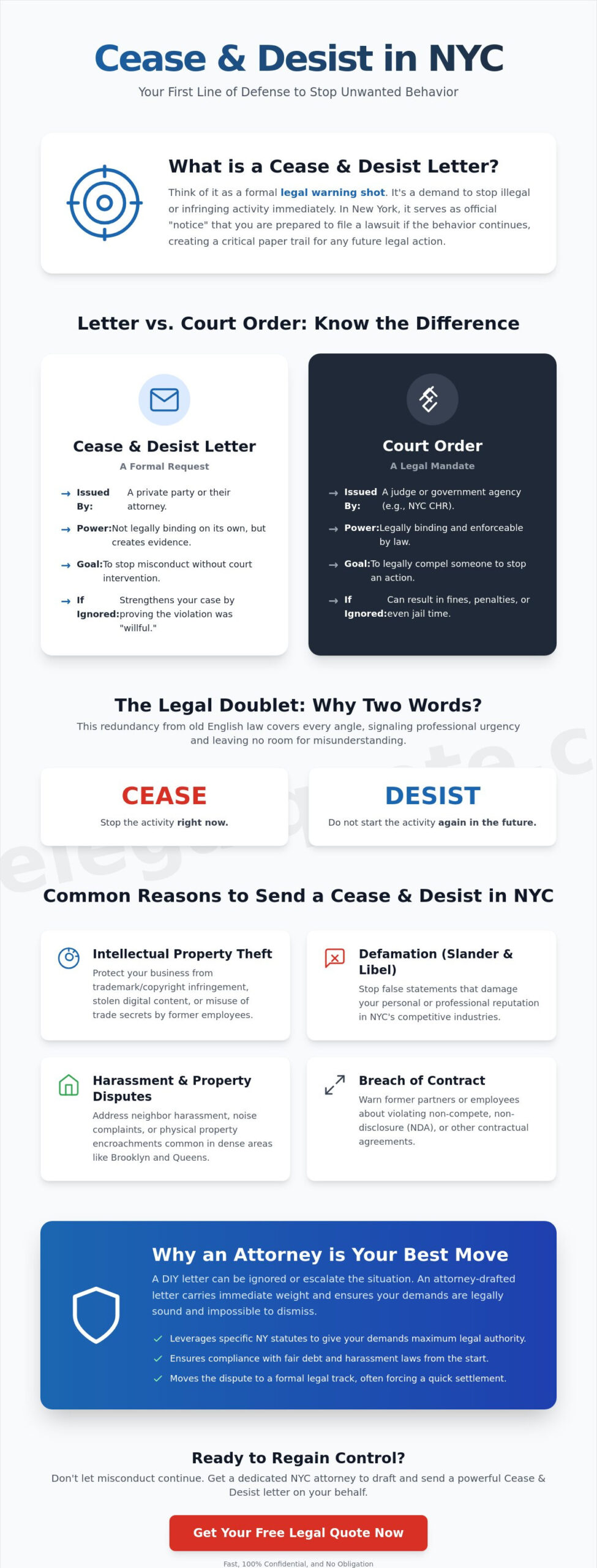
Cease and Desist Letter vs. Court Order: Key Differences
Don’t confuse a warning with a mandate. While both tools aim to stop harmful behavior, they operate on different levels of the NYC legal system. A cease and desist letter is a private demand sent from one party to another. It isn’t a court document. It doesn’t carry the threat of jail time. Instead, it serves as a high-stakes warning shot. In contrast, a court order is a directive signed by a judge. Ignoring an order is a direct challenge to the court’s authority and can lead to immediate contempt charges or heavy fines.
The Power of the Private Letter
Most legal battles in New York never reach a courtroom. Statistics from the legal industry suggest that nearly 90% of disputes are settled through correspondence before a formal lawsuit is even filed. This makes the private letter an incredibly efficient tool. It’s fast, direct, and costs a fraction of full-scale litigation. While a lawsuit in Manhattan or Brooklyn can take years to resolve, a well-drafted letter often gets results in 10 business days.
To ensure your letter carries weight, it must look professional. Citing authoritative definitions, such as those provided by Cornell Law School on Cease and Desist Letters, helps establish that your demands are grounded in established law. A private letter also serves as a “good faith” effort. NYC judges typically expect you to try and resolve issues privately before you take up their time. If you jump straight to a lawsuit, the judge might view you as aggressive rather than reasonable.
When a Court Order is Mandatory
Sometimes a letter isn’t enough. If someone is currently leaking your trade secrets or actively damaging your reputation on social media, you can’t wait for a response. You need immediate action. In these high-stakes scenarios, NYC courts allow you to seek a Temporary Restraining Order (TRO). This is an emergency measure that bypasses the standard notification period to stop the damage instantly.
Strategic timing is everything. You should send a letter when you want to preserve a relationship or save money. You should go to court when the threat is imminent and irreversible. If you’re unsure which path to take, you can find free legal advice online to help you weigh your options. NYC courts handle thousands of these claims annually, and having a trusted advocate to match you with a subscribing attorney can make the difference between a quick resolution and a long, expensive battle. Don’t wait until the damage is permanent. Take action now to protect your rights.
How to Draft an Effective Cease and Desist in New York
A strong cease and desist letter is your first line of defense. It stops misconduct before it reaches a courtroom. In New York, your letter must be factual and firm. Start by identifying the specific behavior. Don’t use vague terms. If a competitor is using your trademark, list the exact dates and URLs where the infringement occurred. Facts win cases. You need to provide a clear, chronological account of the alleged misconduct to show the recipient you’ve been paying attention.
Citing specific laws adds immediate weight to your claim. For business disputes, you might reference New York General Business Law Section 349, which covers deceptive acts and practices. If the issue involves a property dispute in Manhattan, cite the relevant NYC Administrative Code. This tells the recipient that you’ve done your homework and are ready for a legal battle. It transforms a simple complaint into a formal legal notification.
Give the recipient a firm timeframe to respond. NYC attorneys typically set a deadline of 10 to 14 days. This window is long enough to be reasonable but short enough to maintain a sense of urgency. You must include a “What Next” clause. Explicitly state that you’ll pursue litigation if the deadline passes without a resolution. This isn’t a suggestion; it’s a final warning before you take the matter to a New York court.
What to Include (and What to Avoid)
Keep your tone professional and cold. Never draft a letter while you’re angry. Avoid making threats that could be construed as harassment or extortion; these can backfire during a trial. Instead, focus on the evidence. Attach copies of signed contracts, dated screenshots, or photos of the behavior. Providing this proof upfront often forces the recipient to settle quickly because they see the strength of your position.
The Delivery Method Matters
How you send the letter is as important as the content. NYC attorneys rely on Certified Mail with Return Receipt Requested. This establishes proof of delivery. It prevents the recipient from using the “I never got it” defense in court. For high-stakes letters in the Bronx or Brooklyn, consider using a professional process server. Having a third party hand-deliver the document provides an affidavit of service, which is a powerful piece of evidence in any future litigation.
Don’t let misconduct damage your business or reputation. Get a free legal quote instantly and find a dedicated attorney to protect your rights today.
Why Matching with a Staten Island Attorney is Your Best Move
A DIY cease and desist is often treated as a bluff. In the crowded NYC legal landscape, recipients frequently ignore letters that lack a professional letterhead. A document from a licensed New York attorney changes the dynamic instantly. It proves you’ve invested in your rights and are prepared to enter the courtroom. Legal industry data shows that over 85% of recipients take attorney-drafted notices more seriously than those sent by individuals. You need that immediate impact to stop the unwanted behavior before it escalates.
New York City maintains some of the most complex harassment and debt collection laws in the United States. If your letter is too aggressive or makes false claims, you could face penalties under the NYC Administrative Code. A professionally drafted cease and desist letter ensures your notice is firm but legally compliant. This professional drafting creates a reliable foundation for a potential lawsuit. If the behavior continues into 2026, your attorney will use that initial letter to show the court you attempted a reasonable resolution first.
The Risk of the ‘DIY’ Approach
Errors in self-drafted letters are common. Using the wrong legal terminology can invalidate your notice entirely. Even worse, if you accuse someone of a crime they didn’t commit, you might face a defamation counter-suit. Local expertise in NYC law is non-negotiable for these documents because every borough has distinct nuances in how judges interpret pre-suit notifications. Don’t risk your reputation on a template you found online. A local Staten Island professional knows exactly how to phrase demands to get results without creating liability for you. It’s about protection and precision.
Find Your Match Today
FreeLegalQuote removes the friction from your search. Our platform links you with a subscribing attorney who understands the Staten Island court system and the 13th Judicial District. Whether you are looking for a personal injury attorney to stop insurance harassment or a general litigator to protect your privacy, we find the right fit. We act as your high-speed bridge to legal relief.
Our “No Cost Ever” promise means you can seek a match without any financial commitment or hidden fees. We prioritize your privacy and your time. Get the relief you need by connecting with a dedicated professional who will fight hard for your rights. Stop the stress and start the solution now.
Take Control of Your Legal Rights in NYC
Sending a formal legal warning serves as a powerful deterrent against unauthorized actions, from trademark infringement to personal harassment. In 2026, navigating New York City’s legal landscape requires precision and speed. Issuing a clear notice often prevents expensive litigation before it ever reaches a courtroom. While this notice isn’t a court order, it’s the vital first step in building a case that holds up under New York law. You don’t have to handle these complex legal documents alone or feel intimidated by the process.
Finding the right legal help shouldn’t be a burden. We provide 100% Confidential Matching to ensure your privacy is protected from the very first click. Our service offers Direct Access to NYC Subscribing Attorneys who understand the specific needs of Staten Island residents. There is No Cost Ever for users to find their professional match. Stop feeling overwhelmed and start taking action to secure your rights today. Connect with a Staten Island Attorney for Your Cease and Desist Letter and get the professional support you deserve right now. Your peace of mind is just a few clicks away.
Frequently Asked Questions
Is a cease and desist letter legally binding in New York?
A cease and desist letter isn’t legally binding in New York. It functions as a formal demand for someone to stop a specific action, like trademark infringement or harassment. While it doesn’t carry the weight of a judge’s order, it creates a vital paper trail. If you later file a lawsuit in the New York Supreme Court, this document proves the recipient was aware of their misconduct.
Can I write my own cease and desist letter without a lawyer?
You can write your own cease and desist letter without hiring an attorney. No New York law requires a lawyer to sign this document. However, letters on a law firm’s letterhead often get faster results. According to a 2023 legal industry survey, 70% of recipients take attorney-led demands more seriously than personal notes. Writing your own is a low cost starting point for simple disputes.
What happens if someone ignores a cease and desist letter in NYC?
If a recipient ignores your demand, the next step is typically filing a lawsuit or seeking a preliminary injunction. Ignoring the letter doesn’t lead to immediate arrest, but it does demonstrate willful behavior in court. In NYC civil cases, showing that a defendant ignored a formal warning can help you secure punitive damages or recover legal fees if the case goes to a full trial.
How much does it cost to have an attorney send a cease and desist?
Attorney fees for drafting a demand letter vary based on the complexity of the legal issue. While we don’t set prices, industry reports from 2024 suggest NYC firms often charge flat fees ranging from $500 to $1,500 for a standard cease and desist. Some attorneys might charge hourly rates instead. Getting a quote from a dedicated NYC lawyer helps you understand the specific costs for your situation.
Can a cease and desist letter be used for online harassment?
A cease and desist is a common tool for stopping online harassment or defamation. You can send one to demand the removal of harmful content or to stop persistent digital stalking. If the behavior violates the New York State Human Rights Law or local NYC harassment statutes, the letter serves as the final warning before you involve law enforcement or pursue civil litigation for emotional distress.
Does a cease and desist letter have to be notarized in NY?
No, a cease and desist letter doesn’t need to be notarized in New York to be valid. The letter’s power comes from the legal arguments it presents and the threat of future litigation, not a notary’s seal. Most NYC attorneys recommend sending the letter via certified mail with a return receipt requested. This provides 100% proof of delivery, which is more important than notarization in a courtroom.
What is the difference between a cease and desist and a restraining order?
The main difference is that a cease and desist is a private communication while a restraining order is a court mandate. A judge must sign a restraining order, and violating it can lead to immediate arrest by the NYPD. A demand letter is simply a precursor to legal action. It warns the other party to stop their behavior before you ask a New York court to officially intervene.