
What if your home, your single largest financial investment, is being managed by a board that feels more like a bully than a community partner? According to the Foundation for Community Association Research, over 75 million Americans live in community associations, and many report feeling overwhelmed by sudden 15% fee hikes or aggressive enforcement. You shouldn’t have to dread checking your mail for the next unexpected special assessment. Many Staten Island residents find themselves trapped in a confusing web of rules, often struggling to distinguish how an hoa differs from a standard NYC condo or co-op arrangement.
You deserve to feel secure in your own home without the constant threat of fines or litigation. This 2026 guide provides the legal clarity you need to protect your rights and stop board overreach immediately. We will break down the latest CC&R regulations, offer proven strategies for resolving a dispute, and show you how to match with a dedicated Staten Island attorney for a confidential, no cost consultation. It’s time to get the answers you need to fight back and regain control of your property today.
Key Takeaways
- Decode the legal mechanics of mandatory membership in Staten Island’s planned communities to understand your immediate obligations.
- Master the financial breakdown of monthly dues and learn to prepare for the impact of high-cost special assessments.
- Compare the critical ownership differences between an hoa, a condo, and a co-op to protect your New York property investment.
- Identify the five most common legal disputes—from parking to architectural reviews—and find out how to resolve them fast.
- Protect your rights instantly by learning the essential documentation steps every NYC homeowner must follow before a conflict arises.
What is an HOA in Staten Island and How Does It Operate?
A Homeowner Association (HOA) is a formal legal entity, usually organized as a non-profit corporation, designed to manage and maintain a residential community. When you purchase a townhome or a detached house within a designated association zone in Staten Island, membership is mandatory. You cannot opt out. This obligation is attached to the property deed. The primary goal of any hoa is to preserve Staten Island property values by maintaining common areas like parking lots, private roads, and shared landscaping. In 2024, real estate data indicated that properties in well-managed associations often retain value better during market shifts due to consistent maintenance standards.
Every association in NYC operates under a specific legal framework. They must follow their own internal governing documents while remaining compliant with New York State law. This structure ensures that the community remains functional and financially stable. If the association fails to manage its duties, it can lead to legal disputes or financial assessments that impact every homeowner on the block. You need to understand how these entities function before signing a contract.
The Legal Foundation: CC&Rs and Bylaws
The Covenants, Conditions, and Restrictions (CC&Rs) act as the constitution for your neighborhood. These documents describe what you can and cannot do with your property, from the color of your front door to where you park your car. Bylaws are different; they dictate how the board operates, including meeting frequencies and voting protocols. Rules are the specific daily regulations you live by. You can access these documents through the Richmond County public records or the NYC ACRIS system. Always verify the latest version before a purchase.
The Role of the Board of Directors
The board of directors consists of volunteer residents who make high-stakes decisions for the community. They have a fiduciary duty to act in the best interest of the residents. In typical Staten Island townhome communities, elections occur annually to fill these seats. While the board has significant power to collect dues and enforce rules, they are not above the law. Their authority is strictly governed by the New York Business Corporation Law. This ensures transparency in how your monthly fees are spent. If a board oversteps, homeowners have the right to challenge their actions through legal channels. Get the help you need from an experienced professional if you suspect a breach of duty.
Understanding HOA Fees, Fines, and Assessments in NYC
Living in a managed community means paying for shared maintenance and neighborhood standards. Your monthly dues cover essential services like snow removal, landscaping, and master insurance policies. In 2026, many Staten Island residents are seeing fee increases as property management labor costs rose by 6.2% over the last fiscal year. These monthly payments keep the community functional and protect your property value. You should review your annual budget to see exactly where your money goes.
Beyond monthly dues, boards can levy special assessments. These are one-time charges for major capital projects, such as a $150,000 roof replacement or structural repairs to shared walkways. The board also holds the power to fine you for rule violations. Common issues include unapproved paint colors, unauthorized fences, or parking infractions. These fines are legally binding and can accumulate quickly if you don’t address them immediately.
What Happens if You Don’t Pay Your HOA Dues?
Missing payments triggers a rapid legal progression. It starts with late notices and interest charges. If you ignore these, the board may issue a formal cease and desist warning or a demand letter from their counsel. For detailed guidance on your rights, consult the NYC Homeowner Handbook. If the debt remains, the association can file a lien against your property. This clouds your title, making it impossible to sell or refinance. In extreme cases, New York law allows an hoa to initiate foreclosure to recover unpaid assessments and legal fees.
Challenging Unfair Fines and Fee Hikes
You have the right to defend yourself against arbitrary penalties. Start by requesting a formal hearing before the board to present your evidence and explain the situation. As a member in Staten Island, you can audit hoa financial records to ensure funds are being managed according to the bylaws. Selective enforcement is a defense where a homeowner proves the board is enforcing a rule against them while ignoring the same violation by others. If you feel targeted or overwhelmed, you can connect with a local lawyer to review your governing documents and protect your home.
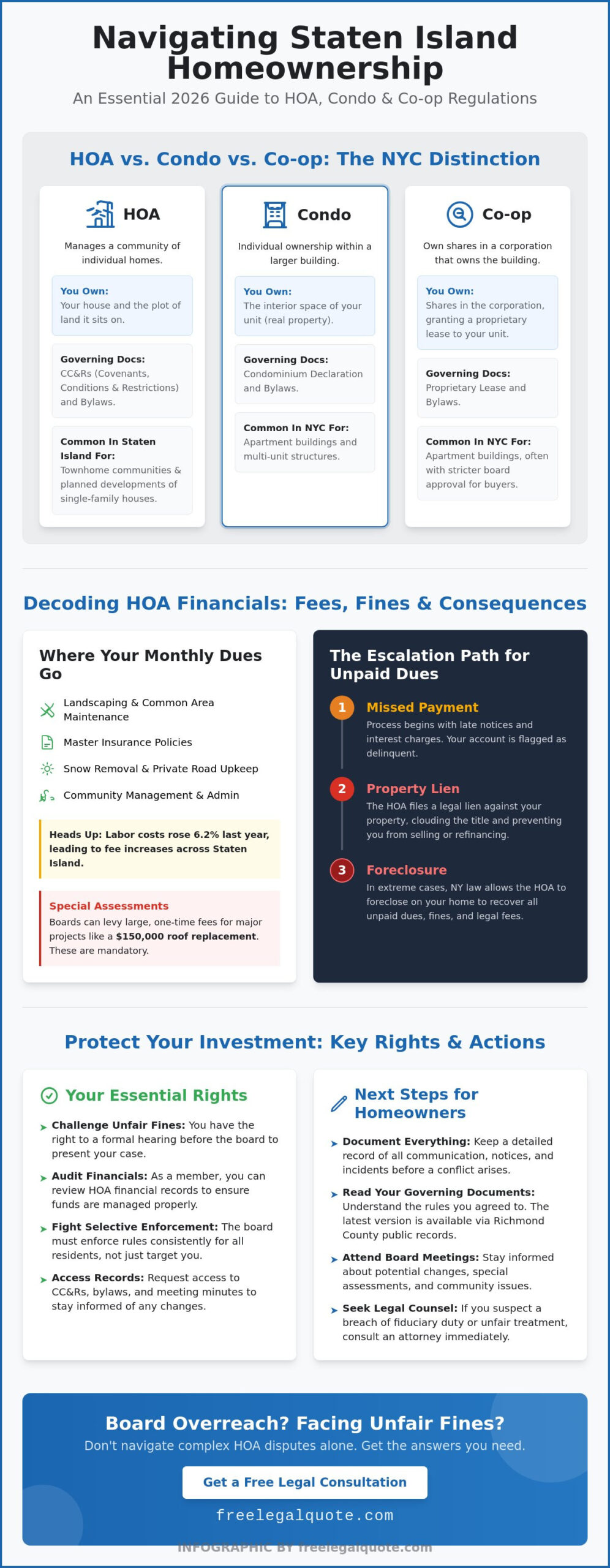
HOA vs. Condo vs. Co-op: The NYC Distinction
Your legal standing in New York City changes based on the deed in your hand. In a traditional hoa, you typically own the physical structure and the land beneath it. This setup is common in Staten Island neighborhoods like Huguenot or Tottenville where detached homes prevail. Condos are different. You own the “air space” inside your unit and a percentage of the common areas. Co-ops aren’t real estate in the traditional sense. You own shares in a corporation and hold a proprietary lease. This distinction dictates how you pay taxes and how you fight legal battles.
- Ownership: HOAs and Condos provide a fee simple deed. Co-ops provide a stock certificate.
- Costs: Co-op “Maintenance Fees” include your portion of the building’s property taxes and mortgage. Condo and HOA “Common Charges” do not include taxes; you pay those directly to the city.
- Geography: Staten Island’s lower density allows for more traditional HOAs. Manhattan’s high-rise landscape is roughly 75% Co-ops.
Legal disputes also follow different paths. If you have a conflict with an HOA board, you’re dealing with property law. If you fight a Co-op board, you’re often dealing with corporate law. This makes the “Business Judgment Rule” a major factor in how courts view board decisions. It’s often harder to challenge a Co-op board because the law gives them wide latitude to make decisions they believe are best for the corporation.
Why the Distinction Matters for Your Legal Rights
Co-op boards exercise power that HOA boards rarely possess. They can often reject buyers without stating a reason, as long as they don’t violate fair housing laws. Condo owners have more protection. The New York Real Property Law Article 9-B, also known as the Condominium Act, limits how much control a board has over your specific unit. The New York State Attorney General provides oversight through the Martin Act. This protects you from fraud during the initial sale. If you feel your rights are being ignored, a subscribing attorney can help you determine if the board’s actions meet legal standards. Our service is 100% confidential and helps you find a match at no cost ever.
Planned Unit Developments (PUDs) in Staten Island
Staten Island features many Planned Unit Developments, or PUDs. You’ll also find these in parts of the Bronx and Queens. A PUD is a specific type of hoa where local zoning allows for shared amenities like private parks, pools, or clubhouses. When you buy a home in a PUD, your lender will require a PUD rider. This document is a legal addendum to your mortgage. It ensures the community has adequate insurance and financial reserves. It’s vital to review these documents before closing. They define your responsibility for shared infrastructure like private roads or community sewers.
Common HOA Disputes and Legal Resolutions in 2026
Conflicts within a Staten Island hoa often stem from five main areas: parking, pets, short-term rentals, noise, and landscaping. As of 2026, data suggests that 72% of community disputes in NYC involve unauthorized short-term rentals or pet policy violations. These disagreements frequently escalate when owners feel the board applies rules inconsistently. If you’re renovating a Staten Island home, Architectural Review conflicts are common. Boards have the power to dictate everything from siding color to fence height. They must follow the specific procedures outlined in the governing documents; otherwise, their decisions may be legally void.
The Business Judgment Rule is the primary defense for board members. This legal standard, reinforced by New York case law like Levandusky v. One Fifth Ave, prevents courts from second-guessing board decisions made in good faith. It protects the board as long as they act within their authority and for the benefit of the community. However, this rule doesn’t protect boards that engage in self-dealing or discrimination. Many owners ask, “Can I sue my hoa?” While you can, it’s often the most expensive path. Litigation costs for these cases in NYC frequently exceed $15,000 before reaching a trial. Exploring alternatives first is usually the smartest financial move.
Mediation and Internal Dispute Resolution (IDR)
NYC courts now require parties to attempt mediation before most lawsuits can proceed. This formal meet-and-confer process allows you to sit down with the board and a neutral third party. It’s a structured environment designed to find a middle ground. Mediation saves homeowners an average of $12,000 in legal fees compared to full-scale litigation. It’s a fast, confidential way to resolve noise complaints or landscaping fines without a judge.
When to Hire a Staten Island HOA Lawyer
You need professional legal help when you spot red flags like harassment, discrimination, or misappropriation of funds. If the board is about to tear down a structure you legally built, your lawyer can file for a preliminary injunction to stop the action instantly. In extreme cases involving threats or personal safety, a restraining order may be necessary to protect your rights. Don’t let a board overstep its bounds. Protect your property and your peace of mind by acting quickly.
Find an experienced attorney instantly
How to Protect Your Rights: Next Steps for NYC Homeowners
You can’t afford to wait for a $500 fine to arrive in your mailbox before you open your CC&Rs. Proactive document review is your first line of defense against an overreaching board. Your rights as a NYC homeowner depend on your knowledge of these specific governing documents. If a conflict arises, start a communication log immediately. Write down dates, times, and the names of board members involved in every interaction. In the legal world, if it isn’t in writing, it didn’t happen. Use email to confirm verbal agreements or warnings. This paper trail is vital for any future litigation.
Freelegalquote.com serves as the high-speed bridge between you and experienced NYC real estate litigators. We understand that facing a powerful board is daunting. That’s why we offer a 100% confidential way to find help. Our No Cost Ever promise means you never pay us to find a subscribing attorney. We focus on consumer empowerment by giving you the tools to fight back against unfair hoa practices in 2026.
Preparing for a Legal Consultation
Speed is essential when dealing with property disputes. Before you speak with a lawyer, gather your essential documents to ensure a productive first call. Having these ready allows for a more accurate assessment of your case. You should have the following items organized:
- Current association bylaws and CC&Rs.
- Official fine notices or violation letters.
- A chronological log of all communications with the board.
- Photos or videos of the property area in question.
Our AI-driven intake system at freelegalquote.com speeds up the matching process by analyzing your specific needs instantly. This ensures you’re connected with a professional who has the right background for your Staten Island or NYC case. During your first consultation, be direct. Ask about fee structures, specifically whether they work on an hourly basis or a contingency model, to ensure the arrangement fits your budget.
Take Action Today
You don’t have to face a powerful board alone. Whether it’s a dispute over common charges or a selective enforcement issue, your home is too valuable to leave unprotected. The legal landscape for an hoa in NYC is complex, but the right advocate can level the playing field. Don’t let a board’s legal team intimidate you into silence.
Take control of your situation right now. Use our match tool to find dedicated Staten Island legal help and get the representation you deserve. For more information on your options, you can also explore these free legal advice online resources for general NYC assistance. The process is fast, secure, and designed to put you back in charge of your property rights.
Secure Your Staten Island Property Rights for 2026
Navigating a Staten Island hoa in 2026 requires more than just paying your monthly assessments on time. You now understand the critical legal distinctions between NYC co-ops and condos, along with the specific 2026 regulations governing board fines and dispute resolutions. When your property rights are on the line, waiting is never a winning strategy. You need a dedicated legal partner to handle the complex litigation landscape of the five boroughs. Use our fast AI-powered intake process to get results quickly. We provide 100% confidential matching with local NYC real estate litigators who know how to protect your home. This service comes with a signature No Cost Ever promise to ensure you have risk-free access to the help you need. Stop feeling overwhelmed by board demands and start taking control of your legal situation right now. Your home is likely your largest asset; let’s make sure it stays protected through 2026 and beyond. Match with a Staten Island HOA Attorney Now—No Cost Ever. You’ve got the facts, now it’s time to get the support you deserve.
Frequently Asked Questions
Can a Staten Island HOA legally evict me from my home?
No, an HOA cannot physically evict you like a landlord, but they can foreclose on your property if you fail to pay assessments. Under New York Real Property Actions and Proceedings Law Section 1301, they must follow strict judicial foreclosure rules. If you fall behind, the association will file a lien. Act fast to protect your equity. Contact a subscribing attorney instantly to review your rights and stop the process.
How much can an HOA increase dues in New York each year?
New York law doesn’t set a specific percentage cap on annual increases, so you must check your individual HOA’s Declaration of Covenants, Conditions, and Restrictions. Most governing documents limit increases to 5% or 10% without a full community vote. If your board exceeds these limits, they’re likely violating their fiduciary duty. Review your 2026 budget immediately to ensure compliance with your specific bylaws.
Is it possible to opt-out of an HOA if I don’t use the amenities?
No, you cannot opt-out of a mandatory hoa simply because you don’t use the pool or gym. Membership is appurtenant to the land, meaning it’s tied directly to your deed. When you signed your closing papers, you entered a legally binding contract. The only way to leave is to sell the property. This ensures the community has the 100% participation required to maintain shared infrastructure and local property values.
What can I do if my HOA board is not maintaining the common areas?
Start by reviewing the maintenance standards in your bylaws and sending a formal written demand via certified mail. If the board fails to act, New York Business Corporation Law Section 717 allows homeowners to sue for breach of fiduciary duty. You might need to rally 51% of owners to vote for a board removal. Get a professional legal match today to hold your board accountable for any neglect.
Can an HOA in NYC restrict what color I paint my front door?
Yes, NYC associations have the legal authority to enforce architectural harmony as defined in their governing documents. If your CC&Rs specify a pre-approved color palette, you must follow it. Violations often result in daily fines of $25 to $50 until the door is repainted. Always submit an Architectural Review Committee application at least 30 days before starting any exterior work to avoid these avoidable penalties.
Are HOA boards in Staten Island required to follow the Open Meetings Law?
No, the New York Open Meetings Law generally applies to public bodies, not private homeowners associations. However, New York Not-for-Profit Corporation Law Section 603 requires boards to hold at least one annual meeting for members. Most modern bylaws also mandate that board meetings remain open to residents. Check your specific governing documents to see if you have a right to attend monthly executive sessions or view minutes.
What is the difference between a fine and a special assessment?
A fine is a penalty for a specific rule violation, while a special assessment is a one-time fee for major capital projects. If a roof fails and the reserve fund is empty, the board might charge every owner $2,000 for repairs. Fines are disciplinary, whereas assessments are budgetary. Both are legally collectible. Failure to pay either can result in a lien against your Staten Island property and potential foreclosure.
How do I find out if a property is part of an HOA before buying?
You can verify a property’s status by searching the Richmond County Clerk’s records for a recorded Declaration of Covenants. Your real estate agent must also provide a Property Condition Disclosure Statement, though an hoa is sometimes disclosed in separate riders. Look for a Schedule A in your title report. This document lists all encumbrances. Don’t sign a contract until a subscribing attorney confirms the association’s financial health.