
Your physical safety shouldn’t depend on how well you understand 500 pages of New York legal code. If you need a restraining order in Staten Island or any of the five boroughs, the clock is already ticking. It’s completely normal to feel paralyzed by the NYC court system, especially when you’re trying to distinguish between a family offense petition and a criminal complaint while fearing for your well-being. According to recent court administration reports, thousands of New Yorkers struggle to finalize these protections every year because of simple paperwork errors.
We understand that the bureaucracy feels designed to slow you down when you need to move fast. This guide shows you exactly how to secure a legally binding “stay away” order and find a dedicated legal advocate to handle the heavy lifting. You’ll get a clear roadmap through the 2026 court requirements and an instant match with a trusted attorney who will fight hard to ensure your protection sticks. Let’s move from fear to certain legal action right now.
Key Takeaways
- Master the NYC legal terminology, including the vital distinction between “stay away” and “refrain from” orders.
- Navigate the procedural differences between Family and Criminal Court to ensure you meet the correct burden of proof.
- Follow our clear, step-by-step instructions to secure an emergency restraining order and understand what happens during an Ex Parte hearing.
- Learn why having a dedicated subscribing attorney is essential for protecting your rights and ensuring your legal filings are handled correctly.
- Categorize your specific needs to determine if you require a domestic or civil harassment order for maximum safety.
What is an Order of Protection in Staten Island and NYC?
In New York, what most people call a restraining order is legally known as an Order of Protection. This is a powerful court mandate that limits the behavior of someone who has harmed or threatened you. If you’re in a situation where your safety is at risk, you can’t afford to wait. Professional urgency is required to secure your rights and physical safety. Our platform provides a 100% confidential way to get a match with a subscribing attorney who understands the NYC court system. There is No Cost Ever to use our service to find the legal help you need right now.
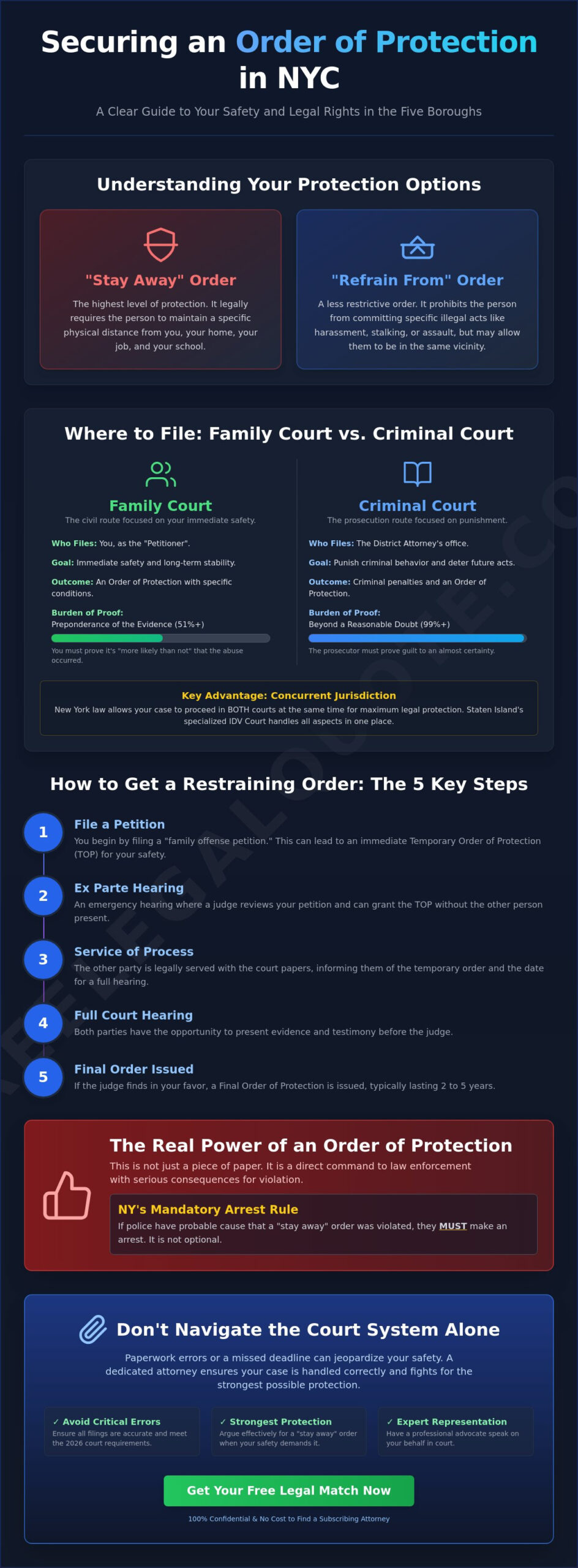
New York judges typically issue two types of conduct restrictions. A “stay away” order is the most protective; it requires the person to maintain a specific distance from your home, school, and place of business. In contrast, a “refrain from” order is less restrictive. It may allow the person to remain in the same vicinity but strictly forbids them from committing illegal acts like harassment, stalking, or assault. You need an advocate who will fight hard to ensure the court grants the specific level of protection your situation demands.
The Legal Power of a Restraining Order
An Order of Protection isn’t just a piece of paper; it’s a direct directive to law enforcement. Under New York Criminal Procedure Law Section 140.10, the NYPD must follow mandatory arrest rules. If an officer has probable cause to believe someone violated a “stay away” provision of a valid order, they don’t have a choice; they must make an immediate arrest. This legal teeth ensures that the restraining order provides real world security.
The process usually starts with a Temporary Order of Protection (TOP). Judges often issue these “ex parte,” meaning the other person isn’t present, to provide immediate safety until a full hearing occurs. A permanent order is the goal of the final litigation. Depending on the court and the severity of the case, these final orders can last between two and five years in NYC.
Who Can Get Protection in New York?
The NYC Family Court handles cases involving “members of the same family or household.” According to Family Court Act Section 812, this includes people related by blood or marriage, former spouses, and individuals who have a child in common. You don’t have to live with the person to qualify for this protection. The law is designed to be inclusive to prevent domestic escalation.
New York also protects those in an “intimate relationship.” This definition is broad; it includes people who are dating or were recently in a relationship. The court evaluates the relationship based on the frequency of contact and the length of time you’ve known each other. If your situation involves a neighbor or a stranger, you’ll likely seek protection through a civil harassment claim or a criminal court case. Finding the right path is faster when you’re connected to a dedicated professional who knows the local rules.
Family Court vs. Criminal Court: Where to File in NYC
NYC provides two distinct paths for legal protection. You don’t have to pick just one. New York law allows for “concurrent jurisdiction,” meaning your case can move through both Family and Criminal courts at the same time. This dual approach maximizes your legal shield. In Richmond County, many complex cases land in the Staten Island Integrated Domestic Violence (IDV) Court. Launched in 2001, this specialized court uses a “one judge, one family” model. It handles your restraining order, custody disputes, and criminal charges all at once. This prevents conflicting orders and saves you from repeating your story to multiple judges. If you need someone to fight hard for your safety, finding a trusted legal match is your best first step.
NYC Family Court: The Civil Route
Family Court focuses on immediate safety and long term stability. You are the “petitioner” here, and you start the process by filing a family offense petition. The burden of proof is a “preponderance of the evidence.” This means you only need to prove it is more likely than not (51% or higher) that the abuse occurred. It is a lower bar than criminal court. The goal is to secure an Order of Protection that sets clear boundaries. This might include “stay away” or “refrain from” provisions. You can find help at these locations:
- Staten Island Family Court: 100 Richmond Terrace, Staten Island, NY 10301.
- Brooklyn Family Court: 330 Jay Street, Brooklyn, NY 11201.
NYC Criminal Court: The Prosecution Route
In Criminal Court, the focus is on law enforcement and punishment. You don’t “file” a case here; instead, you are a complaining witness. The process usually begins when you call the police and an arrest is made. The District Attorney’s office then takes over the prosecution. Because the defendant faces potential jail time, the burden of proof is “beyond a reasonable doubt.” This is the highest legal standard in the United States. A judge can issue a restraining order at the very first arraignment. While you don’t control the case like you do in Family Court, the criminal system offers powerful enforcement tools to keep abusers away.
Deciding which court fits your specific needs can be overwhelming. You need a fast, confidential way to understand your options without a high pressure sales pitch. Our platform offers a no obligation way to get the clarity you deserve instantly.
Types of Restraining Orders: Domestic vs. Civil Harassment
Many New Yorkers believe you can only get a restraining order against a spouse or a live-in partner. This isn’t true. The law provides protection regardless of your specific relationship with the person bothering you. Understanding which category your situation falls into determines which court you visit and how fast you get relief. Your safety shouldn’t wait on a technicality.
If your situation involved physical violence, don’t wait. Beyond the immediate protection of the court, you may have grounds for a lawsuit. Talking to a personal injury attorney can help you recover damages for medical bills or emotional distress caused by the harm. It’s about total protection, both physically and financially.
Domestic Violence Orders of Protection
These orders are designed for “intimate partners” or family members. This group includes current and former spouses, parents who share a child, or people in a current or past dating relationship. If you’re facing threats at home, a judge can issue an “exclusionary order.” This mandate requires the abuser to move out of the residence immediately. It doesn’t matter whose name is on the deed or lease. Safety is the court’s priority. Once the order is signed, the NYPD handles the service of process across all five boroughs. They ensure the defendant is officially notified so the restraining order becomes enforceable right away. This creates an immediate legal barrier between you and the abuser.
Civil Harassment and Neighbor Disputes
Don’t feel trapped if a neighbor, landlord, or stranger is making your life miserable. When there is no family or intimate connection, you’ll typically seek an order through the Supreme Court in NYC. These cases often involve non-stop noise, stalking, or boundary disputes that have turned aggressive. Civil Harassment is a pattern of behavior intended to alarm or annoy without legitimate purpose. In some situations, sending a formal cease and desist letter can be an effective first step to stop unwanted behavior and build a paper trail before pursuing a court order. To secure this protection, you must show the court that the behavior isn’t an isolated incident but a repeated campaign of harassment. This process stops the behavior and gives the police the power to make an arrest if the person approaches you again. It’s a fast, confidential way to reclaim your peace of mind and secure your property. If the harassment is coming from a community board or property management, understanding your rights under an HOA in Staten Island and NYC can help you identify whether board overreach is also a factor in your dispute.
How to Get a Restraining Order in NYC: Step-by-Step
Speed is critical when your safety is at risk. In New York City, the process to obtain a restraining order starts the moment you file a petition. If you’re in immediate danger, you don’t wait for a full trial. You seek an emergency order of protection. This happens through an “Ex Parte” hearing. In this session, a judge listens to your testimony alone. The person you’re filing against isn’t present. If the judge finds an immediate threat, they’ll issue a temporary order on the spot.
Before you step into a courtroom, you need a strategy. Secure free legal advice online to ensure your paperwork is airtight. Small errors in your filing can cause delays you can’t afford. Once the temporary order is signed, the police or a professional process server must notify the other party. They aren’t legally bound by the order until they’re served. This service of process is a mandatory legal requirement that ensures the respondent’s due process rights are respected while keeping you protected.
Preparing Your Petition
Your journey begins with the “Family Offense Petition.” This form is the foundation of your case in NYC Family Courts. You must be specific. General claims of “feeling unsafe” aren’t enough. You need to document the “fear for safety” requirement with precision. Use concrete evidence from the last 90 days to build your case. Don’t leave anything out. Include these items:
- Exact dates and times of every incident.
- Screenshots of threatening texts, calls, or emails.
- Police report numbers, specifically the NYPD “61 forms,” from any prior interactions.
- Photos of physical injuries or property damage.
The Hearing and Enforcement
During your first appearance, the judge reviews your petition. If approved, the order is entered into the NYC Domestic Violence Registry. This electronic system allows any NYPD officer to verify your protection status instantly during a 911 call. This registry is active 24/7 across all five boroughs, ensuring your restraining order is visible to law enforcement in Staten Island or Manhattan alike.
The temporary order is just a stopgap. You’ll eventually face a final hearing or trial. This is where the court decides if the order should last for two to five years. Having a dedicated advocate is vital here. Don’t face a formal trial alone. Get a professional legal match now to protect your future.
Why Professional Legal Representation Matters for Your Safety
Many people assume they should handle a restraining order alone because court forms are technically free. This is a dangerous gamble. While the paperwork exists, the legal strategy behind it doesn’t. Filing for protection is about more than just filling out boxes; it’s about ensuring those protections actually hold up under judicial scrutiny. If you miss a single detail, you might leave court with nothing but a dismissed petition and a false sense of security.
Freelegalquote.com acts as a high-speed facilitator. We aren’t your lawyers. We are the expert connectors. We bridge the gap between your crisis and a real solution. Using our platform carries a “No Cost Ever” promise for the matching process. You get access to a subscribing attorney from our network who takes over the heavy lifting. They fight for your rights while you focus on staying safe. This direct representation is what separates a successful petition from a rejected one.
The Risks of Pro Se (Self-Represented) Filing
Filing pro se often leads to failure. Data from NYC family courts shows that nearly 30% of self-filed petitions face delays or dismissal due to technical errors. By 2026, the court’s digital systems require precise language and specific evidentiary standards. A subscribing attorney uses advanced AI automations to ensure your documents are filed with surgical precision in minutes. Beyond paperwork, there’s the intimidation factor. Standing feet away from an abuser in a Richmond County courtroom is emotionally draining. You shouldn’t have to look them in the eye alone. Your attorney stands between you and the opposition, handling all communication so you don’t have to. Attorneys who invest in exclusive legal leads in Staten Island and NYC are often better positioned to dedicate focused attention to your case rather than juggling dozens of competing prospects.
Finding Your Advocate Today
We believe in the “instant match” philosophy. Staten Island residents need help now, not next week. A dedicated attorney who knows local NYC judges understands the specific nuances of the 18 Richmond Terrace courthouse. They know how individual judges rule on temporary versus final orders. This local expertise is vital when your safety is on the line. Don’t waste time scrolling through directories or calling firms that don’t pick up. We’ve built a system that prioritizes speed, utility, and your empowerment.
Take the first step toward permanent protection. Get matched with a Staten Island attorney now.
Take Control of Your Safety and Future Today
Navigating the NYC court system is a high-stakes challenge that requires immediate action. Whether you’re filing in Family Court or Criminal Court, obtaining a restraining order is the most effective way to establish a legal barrier. In 2026, Staten Island residents must follow a precise step-by-step process to ensure petitions are processed without delay. You don’t have to face these complexities alone. A professional advocate helps turn a temporary petition into long-term security.
Our platform provides 100% Confidential legal matching to connect you with professionals who understand the local courts. There is No Cost Ever to use our service. We give you access to Staten Island attorneys who will fight hard for your safety. Don’t wait for a situation to escalate. Your safety is the priority, and the right legal match is just a few clicks away.
Talk to a Staten Island Lawyer for Free – Get Your Match Now
Take the first step toward a safer life today; you have the strength to protect your rights and your family.
Frequently Asked Questions
How much does it cost to get a restraining order in NYC?
It costs $0 to file for a restraining order in New York City courts. There are no filing fees for domestic violence victims in Family or Criminal Court under New York State law. You don’t have to pay the court to process your application or issue the mandate. If you need a dedicated advocate to help navigate the paperwork, our platform can match you with a subscribing attorney instantly.
How long does a temporary order of protection last in Staten Island?
A temporary order of protection in Staten Island typically lasts until your next scheduled court appearance. This timeframe often spans 14 to 30 days depending on the court’s calendar. The judge decides whether to extend the protection at each subsequent hearing. You must attend every court date at 18 Richmond Terrace to ensure your legal safeguards don’t expire prematurely.
Can I get a restraining order for someone who is harassing me online?
You can get a restraining order for online harassment if the conduct meets the legal definition of stalking or harassment under NY Penal Law. This includes repetitive unwanted emails, social media threats, or doxing. Save every screenshot and digital timestamp as evidence for your petition. A judge will review these 100% confidential records to determine if the digital contact creates a credible threat to your safety.
What happens if someone violates a restraining order in the Bronx or Queens?
Violating a protective order in the Bronx or Queens is a crime that results in an immediate arrest for Criminal Contempt. Police officers in the 40th or 110th precincts are required to make an arrest if there’s probable cause a violation occurred. Penalties include up to 1 year in jail for a class A misdemeanor. Call 911 immediately if the respondent violates a “Stay Away” provision.
Do I need a lawyer to get an order of protection in Family Court?
You aren’t legally required to have a lawyer in Family Court, but navigating the complex petition process is difficult alone. Many petitioners find that a trusted legal advocate helps secure a “Stay Away” provision more effectively than going pro se. We can match you with an experienced subscribing attorney who understands local rules. This ensures your rights stay protected with no obligation to commit today.
Can a restraining order protect my children as well?
A judge can include your children as “protected parties” on the order to ensure their safety at home and school. You must specifically request this and provide evidence of how the respondent’s behavior impacts the minors. This legal shield can prevent the other party from coming within 100 feet of their school or daycare. It’s a vital step for the 100% protection of your entire household.
What is the difference between a “Full” and “Limited” order of protection?
A “Full” order requires the person to stay away from you completely, while a “Limited” order allows contact but forbids illegal acts like harassment. If you have a Full order, the person cannot call, text, or visit your home. A Limited order is common in 60% of cases where families must communicate about children but require a firm legal boundary against any further violence.
How do I serve a restraining order on someone in NYC?
You must have a third party over age 18 serve the papers because you cannot legally serve them yourself. In NYC, the Police Department or a professional process server usually handles this task at no cost to you in domestic cases. They deliver the summons and petition directly to the respondent. Once served, they’ll file an Affidavit of Service with the court to prove the person received notice.