
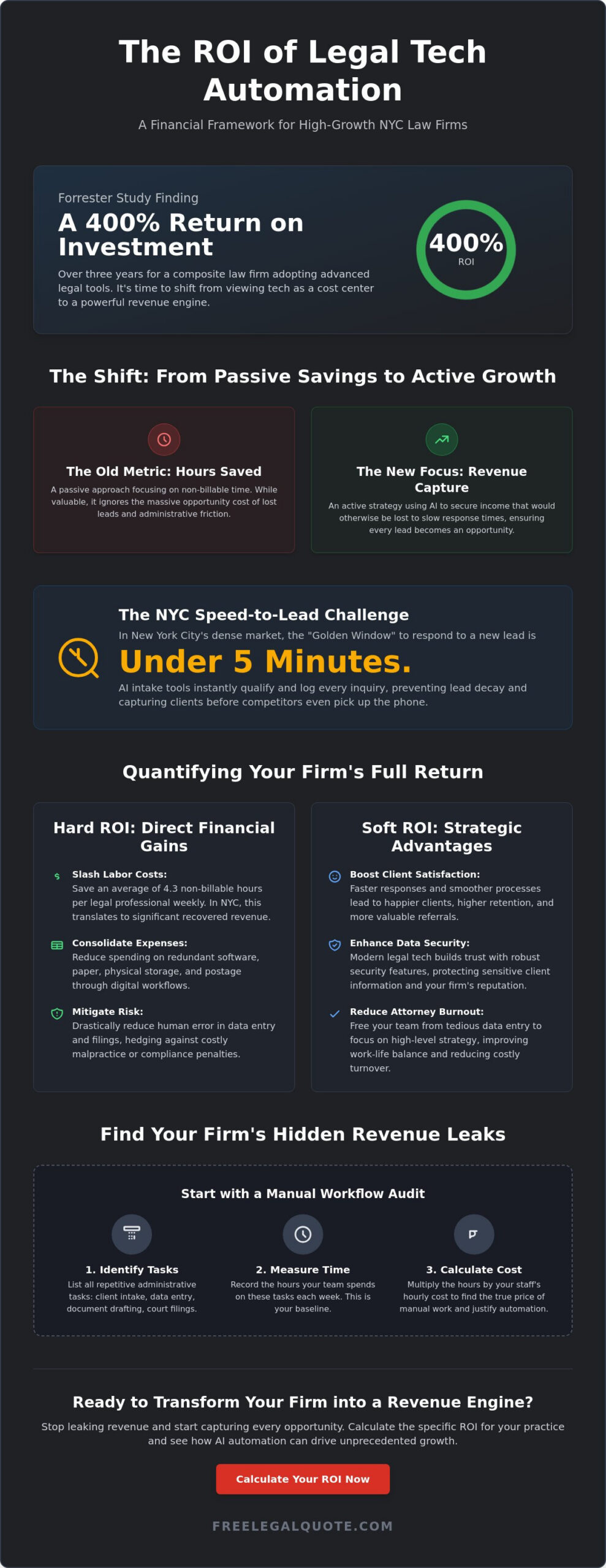
A 2026 Forrester Consulting study revealed that a composite law firm saw a 400% return on investment over three years after adopting advanced legal tools. For many NYC firms, the actual ROI of legal tech automation isn’t just about saving time. It’s about capturing revenue that currently slips through the cracks. You’ve likely felt the sting of losing a high-value client because your intake process was too slow or watched your margins shrink under the high cost of NYC paralegal support.
It’s exhausting to manage administrative burnout while trying to grow a practice. You deserve a system that works as hard as you do. This guide will teach you how to quantify the financial impact of AI automation and transform your firm into a high-growth revenue engine. We’ll walk through a pragmatic formula to justify your tech spend, show you how to slash manual data entry, and reveal the secrets to converting expensive leads before your competitors even pick up the phone.
Key Takeaways
- Use a simple formula to calculate the financial impact of tech. Learn to look past hours saved to find the real profit potential.
- Differentiate between hard savings and soft benefits. This distinction is critical for understanding the true ROI of legal tech automation in a competitive market.
- Protect your marketing budget by hitting the five-minute lead response window. AI intake tools prevent lead decay and ensure you don’t lose clients to faster competitors.
- Audit your current manual workflows to find hidden revenue leaks. Identifying the hourly cost of administrative tasks helps justify the switch to automated systems.
- Prioritize high-impact changes like NYC-specific court filing automations. Start with “low-hanging fruit” to see immediate gains in efficiency and client satisfaction.
What is the ROI of Legal Tech Automation?
In its simplest form, the ROI of legal tech automation is calculated by taking the gain from your investment, subtracting the cost, and dividing that result by the initial cost. It’s a standard financial formula, but for a modern law firm, the inputs are changing. You can’t just measure “hours saved” anymore. While saving non-billable time is valuable, it’s a passive metric. To truly grow, you must focus on “Revenue Capture.”
Revenue capture is the process of identifying and securing income that would otherwise be lost to slow response times or administrative errors. Traditional ROI metrics are often insufficient because they ignore the opportunity cost of a lost lead. If a potential client calls your firm and doesn’t get an immediate response, they’ll call the next firm on the list. Understanding What is Legal Technology? allows you to see how these tools act as a safety net for your firm’s growth by catching every opportunity before it disappears.
The Shift from Cost Center to Revenue Engine
Stop viewing software as an overhead expense. When you implement Attorney ai automations, you’re building an asset that works around the clock. AI reduces “leakage” in your intake funnel by ensuring every inquiry is qualified and logged instantly. Legal tech ROI is the measurable increase in firm profitability achieved by maximizing lead conversion rates while simultaneously slashing the labor cost of manual data entry.
Why NYC Firms Face a Unique ROI Equation
Operating in Manhattan or Staten Island presents challenges that firms in other regions don’t face. The cost of administrative labor in NYC is among the highest in the country. Hiring a new paralegal just to handle intake forms is a massive financial commitment that eats into your margins. Speed-to-lead is also more critical here. In a market this dense, the “Golden Window” for responding to a lead is less than five minutes.
Local regulations, such as the New York City Bar Association Formal Opinion 2024-5, now provide a clear framework for using generative AI ethically. This regulatory clarity means NYC firms can finally move forward with confidence. By automating repetitive court filing tasks and client communications, you bypass the friction of local court speeds and high-cost labor. This targeted approach is the only way to maximize the ROI of legal tech automation in a city where every second and every dollar counts more than anywhere else.
Quantifying Direct vs. Indirect Returns
To get a true ROI of legal tech automation, you must look at your balance sheet through two lenses: hard returns and soft strategic gains. Hard ROI involves tangible savings you can see in your bank account immediately. Soft ROI covers the intangible benefits that protect your firm’s long-term health. You can’t ignore either if you want a full picture of your firm’s performance. Establish a baseline today. Record how much time your team spends on intake, billing, and document drafting before you change a single thing. Without this starting point, your calculations are just guesses.
Hard ROI: Direct Financial Impact
Calculating the reduction in manual labor is the first step toward clarity. A 2026 report found that legal professionals save an average of 4.3 non-billable hours per week by using legal tech. In NYC, where billing rates are premium, those recovered hours represent significant revenue. You’ll also see direct savings by consolidating redundant software and cutting physical costs like paper, storage, and postage. Digital workflows reduce the risk of human error, which acts as a massive hedge against malpractice or compliance penalties that could cost your firm thousands in avoidable fees.
Soft ROI: The Strategic Advantage
It is harder to measure, but Quantifying the ROI of Legal Automation requires assigning value to your firm’s reputation. Improved client satisfaction leads to higher referral rates. Enhanced data security builds trust in a way that marketing never can. Perhaps most importantly, automation preserves your team’s mental bandwidth. When attorneys focus on high-level strategy instead of data entry, burnout rates drop. To value this, look at the cost of attorney turnover in Manhattan. Retaining a single high-performer through better work-life balance is worth more than any software subscription.
Protecting your firm’s profitability means understanding these hidden wins. If you’re ready to see how these numbers apply to your specific practice, exploring exclusive legal leads can help you test your new automated systems with high-quality volume. Focusing on the ROI of legal tech automation ensures your firm remains competitive in a city that never stops moving.
The Revenue Multiplier: Automation and Lead Conversion
Winning a new client in New York City often comes down to who answers the phone first. The “Golden Window” for lead response is now strictly defined as the first five minutes. After this brief period, the probability of qualifying a lead drops by 10 times. If your firm relies on manual callbacks, you’re essentially letting your marketing budget evaporate. The true ROI of legal tech automation is found in its ability to bridge this gap, ensuring that no prospect feels ignored during their moment of crisis.
AI intake bots act as the first line of defense against lead decay. They provide instant engagement, gathering essential case details while the potential client is still on your website. This immediate interaction satisfies the modern consumer’s need for gratification and prevents them from clicking back to the search results to find your competitor. By automating this initial touchpoint, you significantly lower your Client Acquisition Cost (CAC) and increase the lifetime value of every marketing dollar spent.
Eliminating the Response Gap
In practice areas like personal injury or DUI law, emotional urgency is at its peak. The first firm to reach a prospect typically gets the case over 70% of the time. Automation removes the friction of back and forth emails by integrating tools like Google Meet for instant scheduling. This creates a seamless path from interested visitor to scheduled consultation. When you implement AI-driven receptionists, you achieve the ROI of never missing a call without the massive overhead of a 24/7 in-house call center. This ensures your firm remains accessible even during the late night hours when many legal crises occur.
Maximizing the Value of Exclusive Leads
Purchasing Exclusive Legal Leads is a high-stakes investment that requires a high-speed backbone to be profitable. Unlike shared leads, these prospects are yours alone, but their expectations for speed are even higher. You need a comprehensive framework for understanding ROI that accounts for how quickly these leads move through your funnel. A lead that is nurtured automatically with instant SMS updates has a much higher conversion rate than one waiting for a manual callback. Effective automation protects your lead generation spend and solidifies the ROI of legal tech automation by ensuring every high-value opportunity is captured instantly.
Calculating Your Firm’s ROI: A Practical Framework
NYC lawyers don’t have time for academic toolkits or complex spreadsheets. You need a fast, reliable way to see if the math works for your specific practice. Calculating the ROI of legal tech automation requires a shift from gut feelings to hard data. Follow these five steps to build a business case that makes sense for your stakeholders.
- Step 1: Audit current manual workflows. List every task your team performs repeatedly. Focus on intake, billing, and document drafting.
- Step 2: Identify the “hourly rate” of the person performing these tasks. Use the actual cost of your Staten Island paralegal or Manhattan associate. Every minute they spend on admin is a minute they aren’t billing.
- Step 3: Estimate the percentage of automation possible. Most firms can realistically automate 40% to 70% of their administrative burden. Don’t aim for 100% immediately.
- Step 4: Factor in the cost of the AI subscription and implementation time. Include the monthly fee and the few hours your team will spend learning the new system.
- Step 5: Add projected revenue from improved lead conversion. If automation helps you catch just two more high-value leads per month, what is that worth to your bottom line?
The Cost of Inaction (COI) Formula
What is your firm losing every month by staying the same? The Cost of Inaction is often higher than the cost of the software itself. To find your COI, multiply your average lost lead value by the number of leads you miss due to slow response times. Add the cost of attorney “opportunity cost,” which is the revenue lost when a partner does administrative work instead of high-level strategy. Use this total to justify your technology budget. It’s much easier to approve a spend when you realize you’re already “paying” for it through lost efficiency.
Setting Realistic Benchmarks for Success
Total automation is a myth. Aim for the 80/20 rule: 80% of your repetitive tasks should be handled by tech, leaving the complex 20% for your human experts. Track your user adoption rates closely. A common industry benchmark is achieving 80% adoption within the first 90 days. Review your ROI of legal tech automation monthly for the first quarter, then move to annual reviews. This allows you to pivot quickly if a specific tool isn’t delivering the expected gains.
Ready to stop the revenue leaks and start scaling? Join our Attorney Membership Subscription to access the tools and leads you need to turn your firm into a high-growth engine.
Implementation Strategy for Staten Island & NYC Firms
Success in the New York legal market requires more than just high billing rates. It requires an implementation strategy that addresses local friction points. NYC court filing automations are a prime example. With the New York State Unified Court System Rule 22 NYCRR Part 161 now in effect as of June 1, 2026, firms must manage AI certifications in court filings carefully. A pragmatic approach starts with “low-hanging fruit.” Don’t try to overhaul your entire litigation strategy on day one. Instead, begin with intake and free legal advice online filters. These tools act as a digital gatekeeper, ensuring your team only spends time on cases that actually move the needle for your practice.
Ethical compliance is non-negotiable. The New York State Bar Association’s January 2026 guidelines emphasize a cautious, incremental approach to AI. By focusing on administrative tasks first, you protect your practice while maximizing the ROI of legal tech automation. Joining a membership-based ecosystem provides the ongoing support needed to stay current with these evolving rules. You don’t have to figure out the tech alone; you can rely on a community of experts to guide your firm’s digital transition and ensure your interests are always protected.
Scaling Without Increasing Headcount
Staten Island firms often feel the pressure of competing with the deep pockets of Manhattan’s “Big Law.” Automation levels the playing field. It allows a smaller team to handle the volume typically reserved for much larger operations. This is especially true for personal injury attorney services where lead volume can be overwhelming. By automating the initial evidence gathering and client check-ins, you scale your capacity without the high cost of new NYC hires. The path from a pilot project to full firm integration should be rapid but controlled, focusing on one department at a time to ensure high adoption rates.
The Future of Your Practice in 2026
By late 2026, AI automation is no longer a luxury. It is a baseline requirement for survival in the NYC legal market. Clients now expect the same speed and transparency from their lawyer that they get from every other digital service. However, technology should never replace your judgment. The most successful firms maintain a “human-in-the-loop” model, using AI to handle the heavy data lifting while lawyers focus on complex strategy and courtroom advocacy. This balance is the ultimate driver of the ROI of legal tech automation. It’s time to stop managing spreadsheets and start managing growth. Scale your firm with Attorney AI Automations and reclaim your firm’s future today.
Secure Your Firm’s Competitive Edge
Transforming your practice from a cost-heavy operation into a high-growth revenue engine is no longer a theoretical goal. By identifying the hard savings in administrative labor and the soft gains in attorney bandwidth, you can finally master the ROI of legal tech automation. Every minute saved during the intake process is a minute earned for high-level billable strategy. Speed is your greatest asset in the NYC market; capturing leads within the five-minute window is the difference between a thriving practice and a stagnant one.
You don’t have to navigate this digital transition alone. Our platform provides exclusive leads delivered in real-time and AI automations specifically designed by New York attorneys who understand your local challenges. With a risk-free attorney membership subscription, you can begin scaling without the fear of wasted investment or complex implementation hurdles. It’s time to protect your interests and reclaim your time.
Start Automating Your Firm with FreeLegalQuote and watch your firm become the efficient, high-speed facilitator your clients expect. The future of your practice starts with a single step toward better efficiency.
Frequently Asked Questions
How long does it take to see a positive ROI from legal tech automation?
Most NYC firms begin seeing a positive ROI of legal tech automation within three to six months. Initial gains usually appear as recovered billable hours and a noticeable decrease in administrative bottlenecks. By the end of the first year, the cumulative impact of higher lead conversion and reduced manual labor typically outweighs the initial setup costs.
Is AI automation ethical for New York law firms?
Yes, AI automation is ethical as long as you maintain human oversight and protect client confidentiality. The New York City Bar Association Formal Opinion 2024-5 provides clear guidelines for the ethical use of generative AI. You must verify the accuracy of all AI-generated work and ensure your technology partners adhere to strict data privacy standards.
What is the average cost of implementing legal tech for a small firm?
Costs vary depending on the complexity of your workflows and the number of users. Most modern tools use a subscription-based model, which avoids the need for a large upfront capital investment. This approach allows small firms to manage predictable monthly expenses while scaling their technology use as the practice grows.
Can automation help with lead conversion for personal injury cases?
Automation is a game-changer for personal injury lead conversion because it eliminates the response gap. AI intake bots provide immediate engagement, qualifying leads and scheduling consultations while the prospect is still on your site. This ensures you capture high-value cases during the critical first five minutes when a potential client is most likely to sign.
Do I need a dedicated IT person to manage legal AI tools?
You don’t need a dedicated IT specialist to manage modern legal AI platforms. These systems are designed to be user-friendly and are typically hosted in the cloud. The software provider handles the technical maintenance, security patches, and server updates, allowing your team to focus entirely on practicing law.
What is the difference between ROI and COI in legal technology?
ROI measures the profit you gain relative to what you spent on the technology. COI, or the Cost of Inaction, measures what your firm loses by staying with manual processes. If your firm loses two clients a month because of slow intake, the value of those lost cases represents your monthly COI.
How does automation impact the client experience?
Automation significantly improves the client experience by providing instant communication and faster case updates. Clients in the NYC market expect rapid responses and digital accessibility. Providing a seamless, automated intake process builds immediate trust and often results in higher client satisfaction scores and more frequent referrals.
Can AI replace paralegals in a Staten Island law firm?
AI is not a replacement for paralegals but a tool that makes them more effective. By automating repetitive data entry and document assembly, your paralegals can focus on higher-value tasks like case strategy and client advocacy. This shift allows your Staten Island practice to handle a larger volume of work without increasing your headcount.