
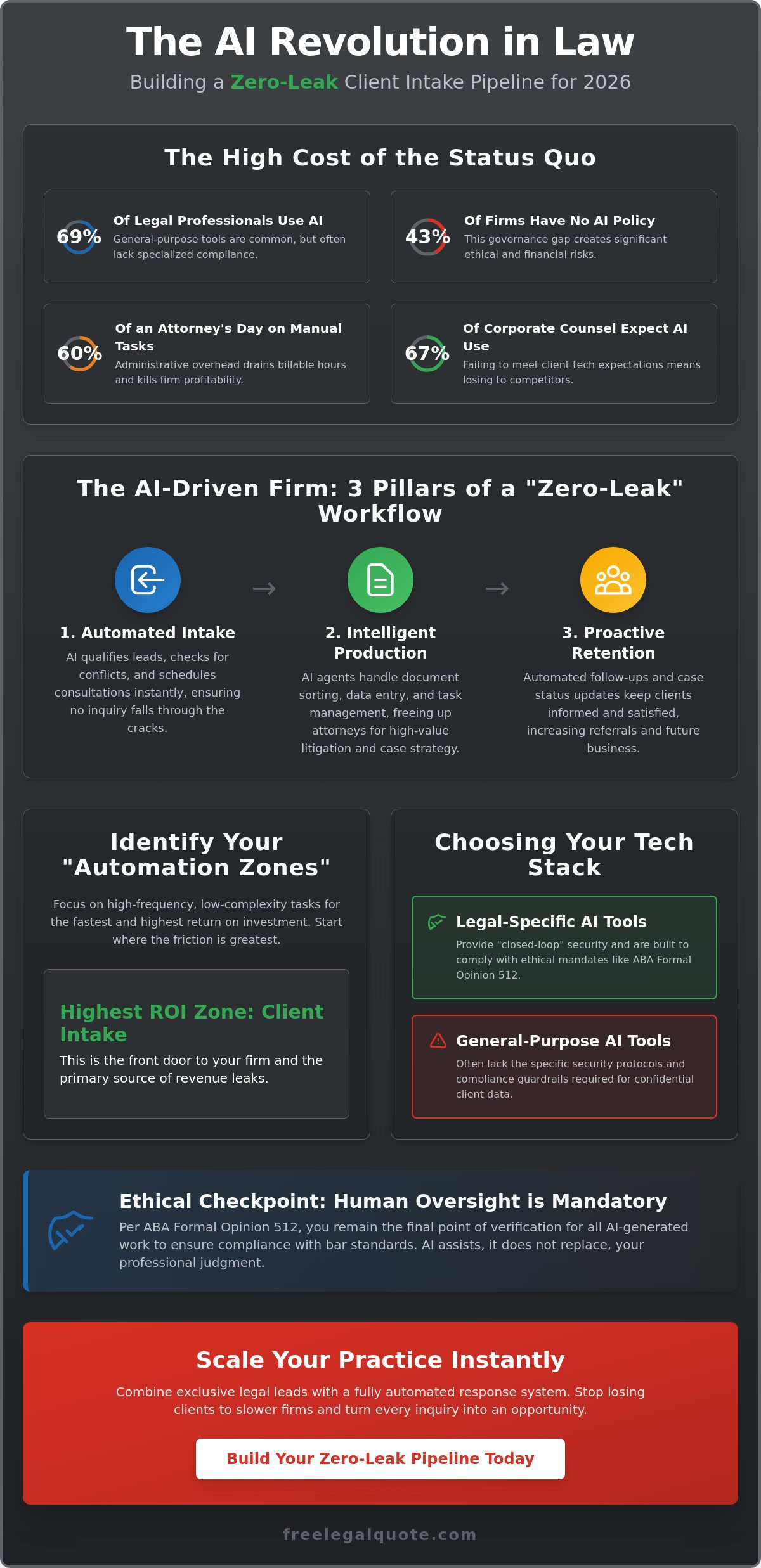
69% of legal professionals now use general-purpose AI tools, yet 43% of law firms still lack a formal policy to govern them. If you’re managing a firm in a high-cost market like NYC, manual client intake isn’t just a nuisance; it’s a financial leak that drains your most valuable leads. You’ve likely felt the pressure from the 67% of corporate counsel who now expect their firms to use advanced generative AI. This is why integrating AI automation into law firm workflows is no longer optional for those who want to protect their margins in 2026.
We understand that the confusion over legal-compliant tools and ethical mandates like ABA Formal Opinion 512 can feel overwhelming. This guide provides the exact step-by-step process to secure a zero-leak client intake pipeline and slash administrative overhead. You’ll learn how to move from basic chatbots to agentic AI systems that run on autopilot. We’ll preview the top-rated compliant tools for 2026, explain how to navigate the latest ethical and compliance requirements, and show you how to regain time for high-value litigation.
Key Takeaways
- Stop wasting potential revenue by building a “Zero-Leak” workflow that bridges the gap between initial inquiry and case management.
- Identify your firm’s “Automation Zones” to focus your budget on high-impact tasks like client intake where AI delivers the highest immediate ROI.
- Master the step-by-step process for integrating AI automation into law firm workflows without compromising client confidentiality or data security.
- Discover why purpose-built legal tools provide the “closed-loop” security and compliance that general-purpose AI platforms often lack.
- Scale your practice instantly by combining Exclusive Legal Leads with automated response systems to ensure no inquiry goes unanswered.
From Manual to “Zero-Leak”: Why AI Workflows are Essential in 2026
The legal market in 2026 has no room for “leaky” processes. A “Zero-Leak” workflow is the seamless integration of lead intake and case management where no inquiry falls through the cracks. For firms in Manhattan and Staten Island, manual administrative tasks have become the primary profit killer. When your staff spends hours on data entry instead of billable work, your margins shrink. By integrating AI automation into law firm workflows, you eliminate the gap between a new inquiry and a signed retainer. This isn’t just about efficiency; it’s about survival in a market where local competitors are rapidly automating their outreach.
We’ve moved past the era of simple chatbots that just answer basic questions. Today, 15% of elite firms use “agentic AI” to execute multi-step logical sequences. These systems don’t just draft text; they trigger actions across your entire software stack. If you aren’t adopting these tools now, you’re handing your market share to firms that can respond to a lead in seconds rather than hours. The evolution of Legal Technology (Legal Tech) has shifted from basic digital filing to these autonomous, high-speed systems that work while you sleep.
The High Cost of the “Status Quo” for NYC Attorneys
In a fast-paced NYC environment, slow response times are a death sentence for lead conversion. Research shows that attorneys often spend up to 60% of their day on manual tasks like scheduling and document sorting. This is a massive hourly loss that high-volume firms can no longer afford. The “subscribing attorney” who leverages modern tech doesn’t just work harder; they work smarter by automating the “busy work” that kills productivity. If you don’t close the gap now, the high cost of administrative staff in New York will continue to eat your litigation profits. Speed is the new currency, and manual systems are too slow to compete.
Defining the AI-Driven Legal Workflow
A modern, automated firm stands on three pillars: Intake, Production, and Retention. AI agents now manage the heavy lifting within these pillars by handling complex sequences that previously required human oversight. They can screen a lead, check for conflicts, and schedule a consultation without a single click from your team. This level of precision ensures that your high-value litigation stays the priority. AI workflow automation is the orchestration of legal tasks to minimize human intervention. By integrating AI automation into law firm workflows, you turn your practice into a high-speed bridge between a client’s problem and your legal solution.
Identifying Your “Automation Zones”: Where AI Delivers the Highest ROI
Success in 2026 requires more than just buying software; it demands a strategic map of where AI can actually move the needle. You don’t need to automate every single task at once. Instead, categorize your firm’s activities into “High-Impact Zones” based on how often they repeat. High-frequency, low-complexity tasks offer the fastest return on investment. By integrating AI automation into law firm workflows in these specific areas, you free your staff from the administrative grind that currently caps your firm’s growth. Start where the friction is highest.
While many firms experiment with research, the primary zone for immediate revenue growth is client intake. If your firm isn’t responding to inquiries within minutes, you’re losing clients to competitors who are. Integrating AI automation into law firm workflows ensures that your internal operations keep pace with the 67% of corporate counsel who now expect tech-driven efficiency. However, every automation must pass through the “Ethics Zone.” Per ABA Formal Opinion 512, issued July 29, 2024, you remain the final point of verification for all AI-generated work to ensure compliance with New York Bar standards.
Intake Automation: The Front Door of Your Firm
Your firm’s first impression is often handled by a machine. AI screening tools qualify leads by asking logic-based questions before a human attorney ever sees the file. This ensures your time is spent only on viable cases. Automated scheduling further secures the pipeline by instantly booking a legal consultation directly into your calendar. This eliminates the back-and-forth emails that lead to “no-shows.”
Practice-Specific Automation: Personal Injury vs. DUI
The ROI of automation varies by practice area. For a personal injury attorney, the biggest bottleneck is often medical record retrieval. AI agents can now request, track, and summarize thousands of pages of data in a fraction of the manual time. In DUI defense, automation streamlines evidence discovery and ensures Staten Island-specific court filing requirements are met every time. If you’re looking to scale, consider how Attorney ai automations can specifically target these practice bottlenecks. For a deeper look at how local firms are adopting these systems, the AI automation tools for Staten Island attorneys 2026 trend report breaks down which technologies are delivering the highest ROI across Richmond County practice areas.
Choosing Your Stack: Legal-Specific AI vs. General Automation
Choosing the right technology stack is the difference between a high-speed practice and a security nightmare. You have two main paths: purpose-built legal AI or general-purpose automation tools. Legal-specific platforms are designed with attorney-client privilege in mind. General tools like Zapier or public versions of OpenAI offer flexibility but often lack the necessary guardrails for sensitive data. When integrating AI automation into law firm workflows, the safety of your data must come first. A general LLM might use your sensitive filings to train its next model; a dedicated legal tool won’t. This distinction is why 34% of firms have already implemented legal-specific AI as of April 2026.
The cost of these tools varies significantly. For example, as of March 2026, Clio’s annual billing starts at $49 per user for EasyStart, while more advanced plans like Expand reach $149. In contrast, general tools like monday.com start at $9 per seat as of February 2026. While the lower entry price of general tools is tempting, the ROI for a attorney often comes from the specialized features found in legal-specific stacks. These tools understand “litigation” and “probate” out of the box. They align with the “No Cost Ever” consumer model by ensuring that the leads you pay for are processed through a secure, professional pipeline that respects user privacy.
The Security and Compliance Checklist
Security isn’t just a preference; it’s a mandate. NYC legal professionals must ensure their stack meets specific encryption and data residency standards. Use this checklist when evaluating online legal services providers:
- Verify SOC2 Type II compliance for data handling.
- Confirm the provider offers a “Zero-Training” guarantee, ensuring your client data is never used to train public AI models.
- Ensure the tool provides an audit trail that meets ABA-approved tech standards for supervision.
Don’t skip these steps. Non-compliance under the EU AI Act or local Colorado AI Act regulations can lead to massive penalties.
Integration Capability: Can Your Tools Talk?
A siloed tool is a broken tool. If your intake software doesn’t talk to your practice management system, you’re just creating more manual work. The goal of integrating AI automation into law firm workflows is to create a seamless data flow. Look for tools with robust API connectivity. This allows a lead from a referral service to move instantly into your case file without a single keystroke. If a tool is too complex for your non-technical staff to use daily, it will eventually become “shelfware” that drains your budget without adding value. Before finalizing your stack, review the law firm AI automation tools Staten Island 2026 readiness checklist to ensure every platform you select meets the compliance and integration standards required for New York practice.
A Step-by-Step Guide to Integrating AI into Your Daily Operations
Success doesn’t happen by accident. Integrating AI automation into law firm workflows requires a phased approach that protects your current caseload while building for the future. Start by mapping every manual step in your intake and document creation. Many NYC attorneys realize their biggest bottleneck is the “dead time” between a lead’s inquiry and the first follow-up. Use flowcharts to visualize the path from a new inquiry to a retained client. This clarity reveals exactly where your firm is losing money. You can’t fix what you haven’t measured.
Once you’ve mapped the friction, pilot a single “Automation Zone.” Automated lead follow-up is the best place to start. It allows you to measure “Time to First Contact” without overwhelming your staff. You must also establish a formal AI Ethics Policy. As of March 2026, 43% of firms still lack these guidelines. Your policy should mandate human verification for every AI output. Train your team on prompt engineering and verify results against primary sources. Review your ROI monthly to decide when to expand into more complex litigation research. Integrating AI automation into law firm workflows is a marathon, not a sprint.
Mapping Your Workflow for Automation
Find the bottlenecks in your Manhattan or Staten Island practice. If document sorting takes your paralegal five hours every week, automate it. Use a flowchart to trace every touchpoint. Identify the “sanity check” points where a human must intervene. This prevents errors from scaling and keeps your practice compliant with local bar standards. Clear visualization is the first step toward a zero-leak pipeline.
The “Pilot Program” Approach
Don’t disrupt your entire firm at once. Start small with intake to prove the concept. Tracking your lead response speed will show immediate value. After the pilot succeeds, you can expand to Attorney ai automations for case-specific work. This incremental growth ensures your team remains comfortable with the new tech. Ready to stop the leaks in your pipeline? Explore our Attorney ai automations today.
Scaling with freelegalquote.com: Automating the Intake-to-Lead Pipeline
Internal efficiency is only half the battle for a modern firm. Integrating AI automation into law firm workflows is most effective when it connects directly to your primary lead source. Freelegalquote.com serves as the high-speed bridge between a local resident’s legal crisis and your professional solution. We don’t just provide raw data; we provide a starting point for a retained case. Our platform functions as an expert connector for attorneys across Manhattan and Staten Island. We ensure that the flow of new business never stops. This allows you to focus on high-value litigation while we handle the digital front door. By the time a lead hits your inbox, the heavy lifting of screening is already done.
A “Zero-Leak” pipeline requires a constant stream of high-intent inquiries. When you combine our Exclusive Legal Leads with your internal automated response systems, you create an unbeatable competitive advantage. There is no delay. There is no manual data entry. The lead flows from our AI-driven intake directly into your practice management software. This synergy ensures you are the first firm to reach a potential client every single time. In a market where 67% of corporate counsel expect tech-driven speed, this level of integration is the only way to maintain a dominant presence.
Maximizing Conversion with Exclusive Leads
Shared lead pools are a race to the bottom. They force you to compete on price and speed against multiple other firms simultaneously. Our model focuses on exclusivity. One lead for one attorney. The math is simple; one-to-one leads convert at a significantly higher rate because you aren’t fighting through a crowded inbox. Our AI-driven intake screening filters out the noise by pre-qualifying leads for your specific practice area. This pragmatic approach ensures you stop paying for “junk” inquiries. Instead, you start investing in a predictable growth-as-a-service model through our Attorney Membership Subscription. It’s about securing the best cases with the least amount of manual overhead.
Your Next Steps: Joining the Future of Law
Transitioning to a tech-forward practice is easier with a dedicated partner. When you join as a subscribing attorney, you gain access to an ecosystem designed for rapid scale. You aren’t just buying a list of names; you’re subscribing to a high-speed bridge between problems and solutions. Integrating AI automation into law firm workflows allows you to finally step away from the administrative grind. The impact on your firm’s bottom line is immediate and measurable. You get more time to fight for your clients while your intake runs on autopilot. Don’t let manual processes hold your practice back in 2026. Ready to fight hard for your clients? Partner with freelegalquote.com today.
Secure Your Firm’s Future with Automated Growth
The transition to integrating AI automation into law firm workflows is a 2026 necessity. With 69% of legal professionals now using AI tools as of March 2026, the competitive gap is widening. You’ve seen how a “Zero-Leak” pipeline and strategic “Automation Zones” can transform your daily operations. By prioritizing security and choosing the right legal-specific stack, you protect your firm from the ethical risks that 43% of firms currently ignore. This isn’t just about saving time; it’s about securing your place in the NYC legal market.
Operated by NYC Attorney Pasquale Calcagno, freelegalquote.com delivers the exclusive, high-intent leads you need to fuel your new automated systems. Our platform is built for the specific dynamics of Staten Island and Manhattan, offering a high-speed bridge between a client’s crisis and your solution. Start scaling your firm with Exclusive Legal Leads and AI Automations today. Your practice is ready for more high-value litigation and less administrative noise. Let’s get to work.
Frequently Asked Questions
Is AI automation ethical for New York attorneys to use in 2026?
Yes, AI is ethical if you maintain ultimate responsibility for the work product. ABA Formal Opinion 512, issued July 29, 2024, mandates that lawyers ensure competence and protect client confidentiality. You must supervise all AI outputs just as you would a junior associate. The lawyer remains the final point of verification for all filings and advice provided to clients.
How much does it cost to integrate AI into a Staten Island law firm?
Costs vary based on your specific software stack and firm size. As of March 2026, Clio’s annual plans range from $49 to $149 per user per month. General tools like monday.com start at $9 per seat as of February 2026. Your total investment depends on whether you choose legal-specific tools or general-purpose automation platforms that require more custom setup. For a structured evaluation framework, the law firm AI automation tools Staten Island readiness checklist can help you compare options against your firm’s specific compliance and budget requirements.
Can AI automations replace my paralegal or legal secretary?
AI automations are designed to augment your staff rather than replace them. These tools handle the repetitive “busy work” like data entry and scheduling. This allows your paralegals to focus on high-value litigation tasks that require human judgment and empathy. It’s about increasing your firm’s total capacity without adding more expensive administrative headcount in NYC.
What is the difference between general AI and legal-specific AI workflows?
Legal-specific AI is built with “closed-loop” security to protect attorney-client privilege. General AI tools often use your data for model training, which creates massive ethical risks for a law firm. When integrating AI automation into law firm workflows, legal-specific tools provide the audit trails and SOC2 compliance that general platforms often lack. Security must be your first priority.
How long does it take to see an ROI from legal automation?
Most firms see a return on investment within the first 30 to 60 days of automating their intake pipeline. By reducing your “Time to First Contact,” you instantly increase your lead conversion rates. More complex litigation automations may take 3 to 6 months to show significant gains in billable efficiency as your team becomes comfortable with the new tools. To benchmark your timeline against current adoption trends, reviewing the AI automation tools for Staten Island attorneys 2026 trend report can provide useful data on how quickly local firms are realizing measurable gains.
What happens if the AI makes a mistake in a legal document?
You are legally and ethically responsible for every document your firm produces. AI hallucinations are a known risk, which is why human verification is non-negotiable for every single draft. If an AI error reaches a tribunal, the attorney of record faces the disciplinary consequences. Always treat AI-generated drafts as a raw starting point rather than a final, ready-to-file product.
How do exclusive legal leads integrate with my existing CRM?
Exclusive leads from freelegalquote.com integrate directly via API or webhook into most major legal CRMs like Clio or Grow. This ensures that high-intent inquiries flow into your system in real-time without any manual data entry. By connecting these leads to your automated response systems, you secure a zero-leak pipeline that operates 24/7 while you focus on case work.
Do I need technical coding skills to set up these automations?
No, modern legal automation tools are designed specifically for non-technical users. Most platforms use “no-code” interfaces where you can drag and drop steps into a logical sequence. While complex logic might require some initial setup help from a specialist, the average attorney can manage daily operations and simple workflow adjustments without ever learning how to write code.