
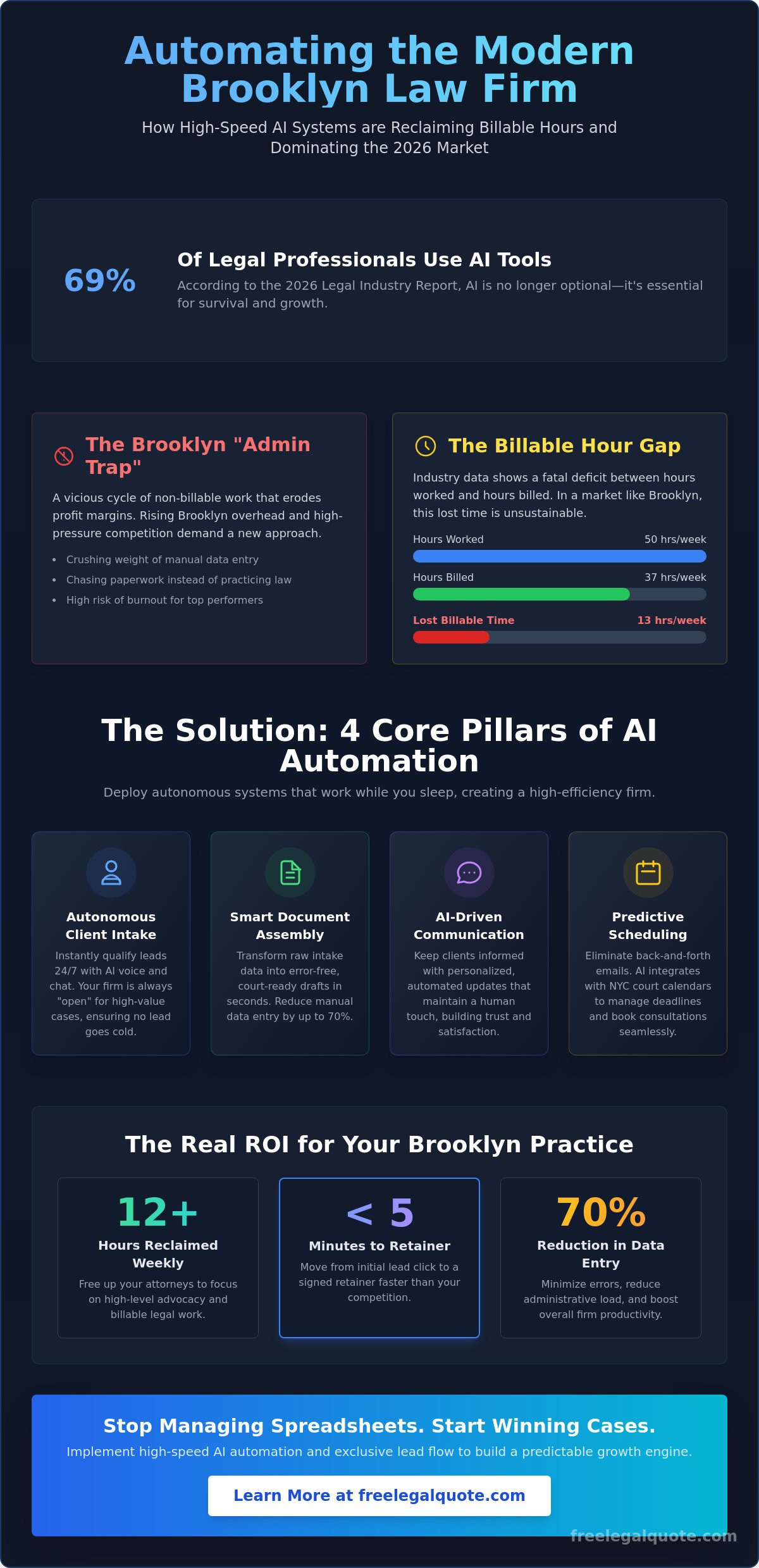
According to the 2026 Legal Industry Report, 69% of legal professionals are now using AI tools to handle their daily workloads. In a high-pressure environment like Kings County, falling behind means watching your billable hours disappear into administrative black holes. You’re likely feeling the crush of high Brooklyn overhead and the frustration of seeing leads go cold because your response time wasn’t fast enough. Automating law firm workflows Brooklyn is no longer a luxury; it’s a survival requirement for any practice that wants to scale without burning out.
You know that every minute spent on manual data entry or chasing paperwork is a minute stolen from your actual legal work. This guide shows you exactly how to reclaim 12 or more hours of billable time every week by deploying high-speed AI automations tailored for the local market. We will explore how integrating NYSCEF-ready systems and instant intake tools can transform your firm into a high-efficiency machine that delivers predictable growth through exclusive lead flow. It’s time to stop managing spreadsheets and start focusing on the high-level advocacy your clients expect.
Key Takeaways
- Identify the specific administrative friction points that are currently leaking revenue and driving up overhead in your Brooklyn practice.
- Discover how automating law firm workflows Brooklyn allows you to reclaim 12+ hours of billable time every week through high-speed AI systems.
- Implement autonomous client intake that qualifies leads and generates filings in seconds, ensuring you never miss a local opportunity.
- Learn to integrate AI-driven tools with NYC court calendars to move from lead click to signed retainer in under five minutes.
- Focus on the “Time-to-Client” metric as your primary KPI to stay ahead of the competition in the 2026 legal market.
The Admin Trap: Why Brooklyn Law Firms Need Workflow Automation in 2026
The Brooklyn legal market in 2026 is a pressure cooker. Between the rising costs of commercial space in Downtown Brooklyn and the aggressive scramble for high-value cases, overhead is reaching a breaking point. If your firm still relies on manual data entry and paper-heavy processes, you are caught in the “Admin Trap.” This cycle of non-billable work doesn’t just eat your time. It erodes your profit margins in a city where every square foot and every staff hour carries a premium price tag. By automating law firm workflows Brooklyn attorneys can pivot from reactive fire-fighting to proactive growth.
Admin fatigue is real. It’s the psychological weight of knowing your to-do list is filled with tasks that don’t require your law degree. When high-performing NYC attorneys spend their mornings chasing signatures instead of drafting motions, burnout isn’t just a risk; it’s a certainty. The 2026 reality is simple. Brooklyn firms face higher overhead than almost any other US market. You can’t afford to let manual processes slow you down while your competitors are moving at the speed of AI.
The True Cost of Manual Intake in NYC
In the 2026 NYC market, manual intake is a leaky bucket. If a potential client reaches out and waits two hours for a callback, they have already contacted three other firms. Brooklyn speed is the primary differentiator. You are likely spending significant marketing dollars to attract leads, only to let them evaporate because a human staff member was tied up on another call. Modern legal technology provides the infrastructure to handle these initial touchpoints instantly, ensuring no lead goes cold.
Consider the overhead. The cost of a full-time paralegal in Brooklyn has climbed steadily, yet much of their time is often wasted on repetitive data entry. AI-driven systems can handle these tasks for a fraction of the cost. This isn’t about replacing your team. It’s about freeing them from the mundane so they can focus on high-value advocacy.
Identifying Your Firm’s Productivity Bottlenecks
Start by auditing your “Lead-to-Retainer” timeline. Where does the friction happen? For many, it’s the “Billable Hour Gap.” Industry data suggests that while attorneys might work 50 hours a week, they often only bill for 37. In Brooklyn, that 13-hour deficit is fatal. You need to bridge that gap by identifying repetitive tasks that require zero legal judgment. Look for these bottlenecks:
- Initial intake qualification and conflict checks.
- Standardized document generation for routine filings.
- Chasing clients for missing information or signatures.
- Manual calendar updates for NYC court deadlines.
Advanced automation systems can reduce manual data entry by as much as 70%. Stop reacting to the chaos of administrative demands. It’s time to build a firm that runs on precision and speed.
Core Pillars of 2026 Attorney AI Automations
Efficiency in the Brooklyn legal market is no longer about working harder. It’s about deploying systems that work while you sleep. By automating law firm workflows Brooklyn practitioners can move from the chaos of manual management to a streamlined, AI-first operation. In 2026, the technology has evolved far beyond simple email templates. We are now seeing autonomous systems that make decisions, qualify prospects, and handle complex scheduling without human intervention.
The foundation of this shift rests on four core pillars. First, autonomous client intake ensures your firm is always “open.” Second, smart document assembly turns raw intake data into court-ready drafts. Third, AI-driven communication keeps your clients informed with personalized updates that maintain a human touch. Finally, predictive scheduling eliminates the endless email chains involved in booking consultations or tracking court dates. These pillars don’t just save time. They create a superior client experience that sets you apart from firms stuck in legacy habits.
Instant Qualification and Lead Nurturing
Stop wasting your time on “tire kickers.” In 2026, AI voice and chat systems can conduct full initial interviews at 2:00 AM. These systems don’t just record messages. They qualify leads based on your specific practice criteria. If a prospect doesn’t meet your requirements, the AI can politely redirect them. This leaves your desk clear for high-value cases. If you want to see how these systems integrate with exclusive legal leads, you can explore modern membership options that fuel this automation engine.
This creates an “Immediate Gratification” loop. A local prospect searches for help, finds your firm, and receives an instant, intelligent response. While your competitors are still checking their voicemail the next morning, your AI has already qualified the lead and scheduled the consultation. This speed is what secures retainers in a market that never slows down.
Automating the ‘Paper Chase’
The days of manually drafting every retainer agreement are over. Smart document assembly pulls data directly from the initial AI intake to generate filings and disclosures in seconds. This isn’t just about speed. It’s about accuracy. Advanced automation systems can reduce manual data entry by as much as 70%. This significantly lowers the risk of NYC court filing rejections due to simple clerical errors.
Integrating e-signatures directly into this flow is essential. Once the AI qualifies a lead, it can instantly send a personalized retainer. The prospect signs on their phone, and the case is opened before you even finish your morning coffee. This seamless progression ensures your firm captures the momentum of a new lead before they have a chance to look elsewhere. It’s a pragmatic approach to protecting your interests and growing your practice without adding to your overhead.
Beyond the Hype: Real ROI for Brooklyn Law Practices
General productivity tools like Trello or Asana often fail because they don’t account for the specific regulatory and filing pressures of Kings County. Automating law firm workflows Brooklyn requires more than just a digital to-do list. It demands systems that understand the “Time-to-Client” metric. In 2026, this is the only KPI that truly matters. If your firm isn’t the first to respond to a local inquiry, you’ve already lost the case to a faster competitor. Speed is your most valuable asset.
Consider the success of a 3-person personal injury firm in Brooklyn. By implementing high-speed AI automations, they doubled their case capacity in six months without adding a single staff member. This isn’t magic; it’s math. They moved from reactive management to a proactive system that handles the heavy lifting of intake and document generation. This allowed the partners to focus on high-stakes litigation rather than chasing signatures. Automation is no longer a luxury for the elite. It’s a competitive necessity for survival in the New York market.
Hype vs. Utility: What to Ignore
Don’t get distracted by “shiny object” AI. If a tool doesn’t directly recover billable hours or capture leads, it’s a distraction. Avoid over-automating areas where a human touch is legally or ethically required. Be especially wary of unverified AI-generated legal research. In 2026, relying on unvetted AI outputs is a fast track to court sanctions. Focus on tactical AI that moves the revenue needle today by handling administrative friction points.
The goal is to protect your interests and your license while maximizing efficiency. Pragmatic firms use technology to bridge the gap between a problem and a solution. They don’t use it to replace the expert judgment that clients pay for. Use tools that provide immediate relief from complex administrative challenges without compromising your professional standards.
Calculating Your Automation ROI
To calculate your return, use a simple formula: (Hours saved per case file × Hourly rate) – Monthly automation cost. Most Brooklyn firms find they recover the cost of their technology subscription within the first few days of the month. Beyond the math, look at your referral rates. Clients who receive instant responses and seamless digital onboarding are far more likely to recommend your services to others. ROI in the legal sector is the direct recovery of non-billable administrative time and its conversion into high-value, revenue-generating legal work.
This structural simplicity is designed to reduce your cognitive load. Stop managing software and start managing your practice. By focusing on billable hour recovery, you create a sustainable model for predictable growth.
Implementing Automation: A 3-Step Strategy for Brooklyn Firms
Transitioning to an automated practice doesn’t happen overnight. It requires a pragmatic, step-by-step approach that respects the complexity of the New York legal system. By automating law firm workflows Brooklyn attorneys can dismantle the administrative barriers that stall growth. Success in 2026 depends on three specific actions that move your firm from manual chaos to digital precision.
First, audit your “Lead-to-Retainer” timeline. Document every touchpoint from the moment a prospect clicks an ad to the second they sign a contract. Where does the process stop? Identify the friction. If a lead sits in an inbox for three hours, that is a failure point. Second, deploy AI-driven intake that integrates directly with NYC court calendars. This ensures your availability is always accurate and your responses are instant. Third, connect your automation engine to a high-intent lead source. Automation is only as effective as the fuel you feed it. If you’re ready to scale, you can explore our attorney membership options to see how exclusive leads integrate with these high-speed systems.
Connecting to the Brooklyn Court System
Your calendar is the heartbeat of your practice. In Kings County, missing a deadline isn’t just an inconvenience; it’s a liability. Your automated system must handle NYC-specific holiday schedules and court closures that differ from federal calendars. Modern systems now allow for direct syncing with Kings County Supreme Court appearances. This ensures your team receives instant notifications for new filings or schedule changes. It reduces the risk of missed dates and the administrative burden of manual tracking.
The ‘Human in the Loop’ Safeguard
Automation should empower your judgment, not replace it. Ethical practice in 2026 requires a “Human in the Loop” strategy. Insert specific attorney review points for document approval and final qualification decisions. This phased implementation aligns with the NYSBA recommendations adopted in January 2026, which advise cautious integration to minimize professional risk. You must also ensure your data security protocols protect the privacy of Brooklyn clients, maintaining strict IOLTA compliance for all financial interactions. This protects your interests while you leverage the speed of modern technology.
If you’re looking to expand your reach beyond Kings County, consider how these same principles apply in neighboring boroughs. You can learn more about Attorney AI Automations: Scaling Your Staten Island Law Firm in 2026 to see how local markets differ. The goal is to build a high-speed bridge between your expertise and the clients who need it most. It’s about being firm on the user’s side while maintaining professional standards.
The Ultimate Synergy: Exclusive Leads and AI Automations
Automation is the engine, but high-intent leads are the fuel. Without a consistent flow of prospects, even the most sophisticated systems sit idle. By automating law firm workflows Brooklyn practitioners can finally capitalize on the “Zero-Lag” workflow. This is the gold standard for 2026. Imagine a prospect clicking an ad, being qualified by your AI, and receiving a retainer agreement in under five minutes. This speed doesn’t just improve efficiency; it secures the client before they even consider a second option. In the competitive Kings County market, being first isn’t an advantage. It’s the only way to win.
We bridge the gap between lead generation and firm operations. Most providers sell you a name and a number, then leave you to do the manual follow-up. We do the opposite. Our ecosystem is built to feed your automation engine directly. This creates a seamless transition from a digital inquiry to a signed case. You stop being a salesperson and start being an advocate. It’s a pragmatic shift that protects your time and ensures your firm remains the most responsive practice in the borough. By removing the friction between “lead found” and “client signed,” you create a rhythm of gratification for the user and predictable growth for yourself.
Why Exclusive Leads Beat Shared Directories
Shared directories are a race to the bottom. When five firms receive the same lead, the conversation quickly turns to who can offer the lowest price. Brooklyn attorneys don’t have the margins to compete on price alone. Exclusive leads change the math of conversion entirely. You become the only choice, not one of many. This exclusivity allows your AI to build immediate rapport without the pressure of a bidding war. To understand how this fits into the broader NYC market, read our Exclusive Legal Leads in Staten Island & NYC: The 2026 Attorney Buying Guide. Focus on quality over quantity to maximize your ROI.
Getting Started with freelegalquote.com
The Attorney Membership is your entry point into this growth ecosystem. It’s not just a subscription; it’s a high-speed bridge to a more manageable practice. We provide the leads, and our technology helps you process them with zero friction. Integration is straightforward and designed to reduce your cognitive load. You don’t need to be a tech expert to see results. You just need to be ready for the volume. Scale your Brooklyn firm today with Attorney AI Automations and reclaim your billable hours. Stop chasing prospects and start closing them with the precision that 2026 demands. This is your opportunity to move from being overwhelmed to being in total control of your firm’s trajectory.
Master the Brooklyn Market with High-Speed Legal Operations
The Brooklyn legal landscape doesn’t wait for anyone. You’ve seen how the admin trap drains your billable potential and how high overhead can cripple even a successful firm. By automating law firm workflows Brooklyn attorneys can finally stop the manual paper chase and focus on the high-level advocacy that wins cases. Success in 2026 requires a perfect synergy between exclusive high-intent legal leads and 2026-ready AI automation tools. This isn’t just about software. It’s about a growth ecosystem operated by NYC attorneys for NYC attorneys.
You now have a clear 3-step strategy to audit your timeline, deploy intelligent intake, and fuel your practice with exclusive prospects. Don’t let your competition be the first to respond while you’re stuck in administrative friction. It’s time to build a firm that is as fast and resilient as the borough it serves. You can take control of your growth right now.
Start Automating Your Brooklyn Practice with Exclusive Leads
Your future as a high-efficiency practice starts with a single decision to work smarter and faster today.
Frequently Asked Questions
How much does it cost to automate a small law firm in Brooklyn?
Investment levels vary depending on your firm’s size and the complexity of the features you deploy. Most Brooklyn practitioners find that the monthly subscription is quickly offset by the recovery of non-billable hours. Instead of focusing on the initial outlay, consider the high cost of manual labor and lost leads in the NYC market. Transitioning to a digital-first model typically pays for itself by reducing the need for additional administrative staff.
Can AI automations handle complex client intake questions?
Yes, 2026-era AI uses advanced natural language processing to conduct intelligent, multi-step interviews. These systems don’t just collect data; they qualify leads based on your specific practice area requirements. If a prospect’s case doesn’t meet your criteria, the system can provide resources or a polite decline. This ensures you only spend time on high-value cases that match your firm’s expertise.
Are AI legal automations compliant with New York State Bar ethics rules?
Modern tools are designed with the New York State Bar Association’s January 2026 recommendations in mind. These guidelines emphasize the importance of attorney oversight and data security. By automating law firm workflows Brooklyn attorneys must ensure a “human in the loop” remains for final legal decisions. Our systems prioritize IOLTA compliance and client confidentiality to protect your professional standing while maximizing efficiency.
Will automating my workflow make my firm feel impersonal to clients?
Automation actually makes your firm feel more responsive and attentive. In a market where speed is everything, a client who receives an instant response feels prioritized. You can customize the AI’s communication style to match your firm’s professional voice. By handling the routine data collection automatically, you free up your personal time for the high-level advocacy and relationship-building that clients truly value.
How long does it take to see an ROI from law firm automation?
Most firms report a positive return on investment within the first 30 days of implementation. This immediate relief comes from capturing leads that would have otherwise gone cold and reclaiming hours previously spent on manual document drafting. When you combine automated intake with exclusive lead flow, the growth becomes predictable. You’ll notice a significant shift in your billable-to-admin ratio almost as soon as the system is live.
Do I need a dedicated IT person to manage these AI tools?
You don’t need a technical background or a dedicated IT department to run these systems. Modern AI-first platforms are built for accessibility and ease of use. Most setups are cloud-based, meaning there is no complex hardware to install or maintain. The focus is on a user-friendly interface that lets you manage your practice from a single dashboard without getting bogged down in code or server maintenance.
What is the difference between general automation and attorney-specific AI?
General tools lack the specific safeguards required for legal practice in New York. Attorney-specific AI is built to handle automating law firm workflows Brooklyn by integrating with systems like NYSCEF for court filings. These tools understand legal terminology, conflict check requirements, and the nuances of client-attorney privilege. Using a generic tool often creates more work because it isn’t designed to meet the rigorous standards of the legal industry.
Can I integrate automation with my existing legal practice management software?
Most 2026 legal automation tools are designed to sync seamlessly with popular practice management and CRM platforms. This connectivity ensures that data flows directly from the initial AI intake into your existing case files without manual entry. Integrating these systems eliminates data silos and reduces the risk of clerical errors. It’s a straightforward way to upgrade your current infrastructure without a complete overhaul of your existing processes.