
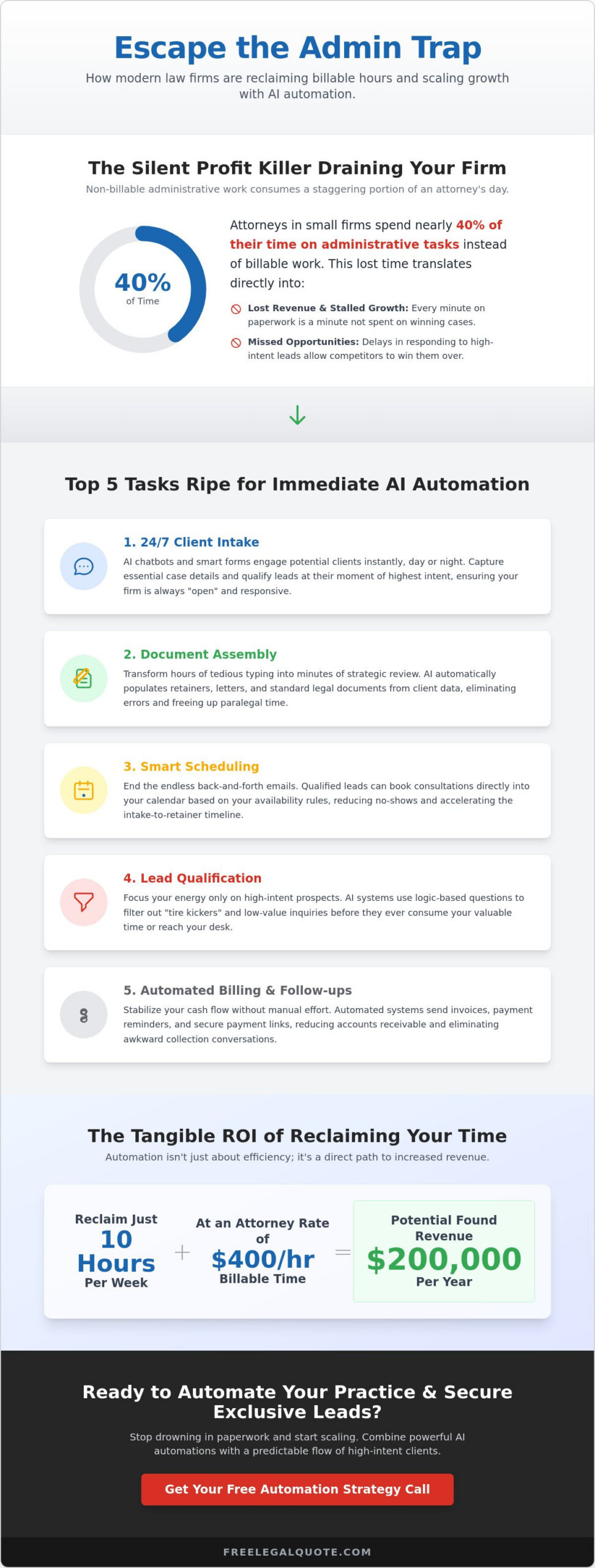
Did you know that attorneys in small firms still spend nearly 40% of their time on administrative tasks instead of billable work? It is a staggering drain on your productivity. You likely feel the pressure of non-billable paperwork every day, and the challenge of automating repetitive tasks in a law firm has never been more urgent. For firms in high-overhead markets like New York, these inefficiencies do more than just waste time. They threaten your bottom line and allow high-intent leads to slip away.
We understand that your value lies in your legal expertise, not in managing spreadsheets or chasing signatures. This guide shows you exactly how to reclaim 20 or more hours every week using the latest AI-driven systems. You can secure a predictable flow of exclusive leads while slashing your administrative costs. We will preview the essential 2026 efficiency tools, from agentic AI assistants to streamlined intake workflows, that transform your practice into a high-velocity operation. It is time to stop drowning in paperwork and start focusing on the cases that matter.
Key Takeaways
- Identify the hidden costs of non-billable hours and how they impact growth in competitive markets like New York.
- Discover the top five administrative areas for automating repetitive tasks in a law firm to reclaim valuable time.
- Learn to distinguish between “passive” legacy software and “active” AI systems that proactively move your legal work forward.
- Follow a pragmatic four-step plan to audit your current workflows and eliminate your firm’s biggest time-wasters.
- See how combining AI-driven automation with exclusive, high-intent leads creates a predictable and scalable growth engine.
The Silent Profit Killer: Why Repetitive Tasks Stall Law Firm Growth
Law firms in New York City face some of the highest overhead costs in the country. Every minute spent on data entry or file organization is a minute you aren’t billing at your full rate. When you spend 40% of your day on administrative burdens, you aren’t just losing time. You’re losing your competitive edge. The process of automating repetitive tasks in a law firm is no longer a luxury for the tech-savvy; it’s a survival strategy for the modern practitioner. Manual data entry is a massive liability, especially for Staten Island firms trying to compete with larger Manhattan practices. One typo in a client’s contact info or a delay in responding to a high-intent lead can cost you a five-figure case. You need to move from reactive administration to proactive scaling to survive this market.
What is Legal Workflow Automation in 2026?
The landscape of Legal technology has shifted from simple cloud storage to fully integrated AI systems. In 2026, automation isn’t just about scanning documents. It’s about creating a seamless path from the moment a lead finds your firm to the moment they sign a retainer. The core objective is to reduce friction. If a potential client has to wait six hours for a callback, they’ve already moved on to your competitor. AI legal automation is the use of neural networks to handle logic-based administrative tasks. These systems don’t just store data; they understand context and trigger the next step in your workflow without human intervention. This shift allows your staff to focus on high-value client interactions instead of shuffling digital paperwork.
The ROI of Reclaiming Your Billable Time
Think about your current weekly schedule. If you reclaim just 10 hours from administrative burdens, what does that look like for your revenue? For an attorney billing $400 an hour, that is an extra $4,000 per week or $16,000 per month in potential billable time. That is nearly $200,000 in found revenue over a single year. Beyond the financial gain, the mental load reduction for partners and associates is massive. Burnout often stems from the “grind” of non-billable tasks, not the legal work itself. When you eliminate the tedious parts of the job, your team stays sharper and more focused on winning cases. Our Attorney ai automations provide immediate relief by taking these burdens off your plate, allowing you to build a predictable and scalable practice without the high cost of additional administrative staff.
Top 5 Repetitive Tasks Ripe for Immediate AI Automation
The transition from a manual practice to an automated one doesn’t happen all at once. It starts with identifying the specific friction points that eat your day. In 2026, the most successful firms use robotic process and intelligent automation to handle the heavy lifting of administrative management. By automating repetitive tasks in a law firm, you stop acting as a glorified clerk and start acting as a high-level strategist. Here are the five areas where AI delivers the most immediate impact:
- 24/7 Client Intake: AI systems handle the initial “hello” so you don’t have to.
- Document Assembly: Templates and AI drafting tools turn hours of typing into minutes of reviewing.
- Smart Scheduling: Prospects book directly into your calendar based on rules you set, ending the back-and-forth email chains.
- Lead Qualification: AI filters out “tire kickers” and low-intent inquiries before they ever reach your desk.
- Automated Billing: Reminders and payment links trigger automatically, ensuring your cash flow remains steady without manual follow-ups.
Transforming Client Intake into a Conversion Machine
Your firm’s responsiveness is the single biggest factor in winning new business. When potential clients search for free legal advice online, they’re often in a state of high stress. They won’t wait for a Monday morning callback. AI chatbots and smart forms qualify these leads instantly, providing immediate engagement while capturing essential case details. This ensures your Staten Island firm is always “open,” even when you’re in court or asleep. It’s about meeting the client at their moment of highest intent and securing the connection before they click on the next search result.
Document Assembly and Electronic Signatures
Drafting routine filings or retainer agreements shouldn’t take all afternoon. Modern AI tools use your existing templates to populate complex documents in seconds. This speed is critical in high-stakes situations. For example, when a client needs a restraining order, the documentation must be accurate and immediate. Automation ensures consistency and reduces the risk of human error in these routine but vital filings. Once the document is ready, integrated electronic signatures allow clients to sign from their phones, moving the case forward without a physical office visit. If you’re ready to scale your practice with these tools, consider how an Attorney Membership Subscription can connect you with the high-quality leads that these automated systems are built to handle.
Beyond Basic Software: Comparing Workflow Tools vs. AI Lead Systems
Many attorneys mistake a digital filing cabinet for a growth engine. Traditional legal CRMs often fail to deliver a true ROI because they are passive tools. They store data but don’t drive action. You still have to manually enter information, set reminders, and click “send” on every email. This creates a “leaky bucket” in your marketing funnel. You spend thousands on advertising, but potential clients slip away because your response time lags. True automating repetitive tasks in a law firm requires “active” AI that bridges the gap between the initial inquiry and the signed retainer.
Active AI systems don’t wait for your command. They trigger workflows the moment a lead interacts with your firm. This proactive approach turns your practice from a reactive administrative hub into a high-speed conversion machine. The process of automating repetitive tasks in a law firm moves beyond simple storage. It’s about moving work forward autonomously within predefined rules. It’s the difference between a software that holds your files and an AI that builds your future.
The “Shared Lead” Problem and How Automation Solves It
In the competitive NYC market, speed-to-lead is the only metric that truly matters. If you are buying leads from a shared pool, you are in a race against ten other firms. Even when you invest in Exclusive Legal Leads, the psychological clock is ticking. Overwhelmed clients want immediate relief. If they don’t get a professional response within minutes, their anxiety drives them to keep searching. Automation ensures you are the first firm to respond to a NYC inquiry, every single time. This instant engagement builds immediate trust and stops the prospect from looking elsewhere.
AI-Driven Lead Qualification: Filtering for Quality
Not all inquiries are created equal. Your intake staff likely spends hours talking to “tire-kickers” who don’t have a viable case. This is a massive drain on resources. AI-driven systems can now separate these low-intent inquiries from high-intent personal injury attorney prospects. By using logic-based questioning, the AI qualifies the lead before it ever reaches your desk.
These systems also handle the long-term nurture. If a lead isn’t ready to sign today, automated follow-up sequences keep your firm top-of-mind while you sleep. This reduces the administrative burden on your intake staff by 50% or more. You stop chasing ghosts and start focusing on the high-value cases that drive your firm’s growth. This efficiency is what allows a small firm to compete with the giants across the bridge.
A Pragmatic 4-Step Plan to Automate Your Law Practice in 2026
Waiting twelve months for a software rollout is a luxury NYC attorneys can’t afford. You need a faster path to efficiency. Reclaiming your schedule starts with a clear, actionable strategy to stop the bleeding of non-billable hours. By automating repetitive tasks in a law firm, you can transition from a bottlenecked practice to a streamlined operation in weeks, not years. This four-step plan focuses on immediate impact and long-term scalability.
First, you must audit your current operations to find the three biggest time-wasters. For many firms, these are manual data entry, lead follow-up, and document drafting. Once you identify these, you can pilot your automation on a single practice area, such as DUI or Personal Injury. This allows you to work out the kinks in a controlled environment before scaling across the entire firm. Finally, review your performance data to ensure your new systems are actually saving time and increasing your lead-to-client conversion rate.
Auditing Your Staten Island Law Firm Workflow
Identifying the specific tasks that delay client onboarding is crucial. You can’t fix what you haven’t measured. We advise firms to log every non-billable task for one week to identify automation targets. This log will reveal exactly where your staff is getting bogged down. Are they spending three hours a day chasing signatures? Is the intake process stalled by manual form filling? Documenting these manual steps is the first step toward mapping them for AI integration. This clarity allows you to see your firm as a series of processes rather than a chaotic pile of deadlines.
Selecting the Right AI Tech Stack
Your tech stack should prioritize AI integration over legacy features that you’ll never use. In the New York market, your tools must play well with existing court systems and filing requirements. Prioritize mobile-first solutions that allow you to manage your practice while moving between Manhattan and Brooklyn courts. Accessibility is key. However, speed shouldn’t come at the cost of security. Ensure any system you adopt maintains strict data privacy and protects attorney-client privilege. The right stack acts as a silent partner, handling the logistics while you handle the law.
If you’re ready to stop wasting time and start growing your practice, get started with our Attorney Membership Subscription to access the leads and tools you need for a modern firm.
Scaling with freelegalquote.com: AI Automations and Exclusive Leads
Efficiency is only half of the growth equation. You can’t scale a firm on streamlined systems alone; you need a steady stream of high-quality cases to fill those pipelines. freelegalquote.com bridges this gap by combining automating repetitive tasks in a law firm with the delivery of exclusive, high-intent leads. We don’t just provide a software tool. We act as your expert connector, building a high-speed bridge between a legal problem and your professional solution. By integrating our AI-driven intake with exclusive lead delivery, you stop the “leaky bucket” problem once and for all.
Smarter technology leads to lower client acquisition costs (CAC). When you remove the manual labor from the intake and qualification process, you reduce the overhead needed to sign a new case. You stop paying for the time your staff spends on dead-end calls or chasing “tire-kickers” who don’t have a viable case. This partnership creates a predictable environment for scaling your NYC or Staten Island practice. Our platform handles the logistics of automating repetitive tasks in a law firm so you can focus on the high-level advocacy your clients expect.
The Exclusive Lead Advantage
Most lead providers sell the same name to five different firms. This creates a race to the bottom where the cheapest or fastest caller wins. We don’t share your leads with competitors. When a lead hits your inbox, it’s yours alone. Our AI qualifies these prospects before you ever see them, ensuring they meet your specific criteria. This immediate, automated intake increases your conversion rate because you’re the first and only professional the client hears from in their moment of need. It’s a low-pressure, high-gratification experience for the client that builds instant trust in your firm.
Getting Started with Attorney AI Automations
We know you’re busy practicing law. You don’t have time to become a software engineer. That’s why our onboarding process for New York legal professionals is designed for speed and simplicity. We handle the technical heavy lifting, from setting up your AI triggers to integrating your lead flow. It’s a straightforward, pragmatic approach that offers immediate relief from administrative burdens. You get the benefits of a modern, automated firm without the typical tech headaches. Our Attorney Membership Subscription is more than a service; it’s a commitment to your firm’s empowerment and long-term success. Streamline your firm with Attorney AI Automations today and start reclaiming your time while you grow.
Take Command of Your Firm’s Future
The era of drowning in non-billable paperwork is over. You’ve seen how automating repetitive tasks in a law firm transforms a bottlenecked practice into a high-speed revenue engine. By auditing your workflow and implementing active AI systems, you can reclaim nearly 40% of your day. This shift isn’t just about saving time; it’s about being the first to respond to every high-intent inquiry in Staten Island and NYC. You don’t have to manage the technical heavy lifting alone.
Our platform provides a seamless bridge between your expertise and the clients who need it most. We deliver exclusive leads to one attorney only, ensuring you never have to race against ten other firms for the same case. With AI-powered intake systems designed specifically by legal tech experts, you can finally focus on the high-level advocacy that defines your professional career. Stop reacting to administrative chaos and start driving predictable growth. Join the Attorney Membership and Automate Your Growth today. Your practice is ready for the next level, and the solution is within reach.
Frequently Asked Questions
How much time can AI automation really save a small law firm?
AI automation can save small firms 20 or more hours every week by eliminating manual data entry and administrative bottlenecks. Since many attorneys in small practices spend nearly 40% of their time on non-billable tasks, these systems provide an immediate boost to your productivity. You can redirect this found time toward complex legal strategy or expanding your client base. It is the fastest way to increase your billable output without hiring more staff.
Is legal automation secure enough to protect attorney-client privilege?
Yes, modern AI systems use enterprise-grade encryption and comply with strict data privacy standards like SOC2 or HIPAA. When automating repetitive tasks in a law firm, you must select tools specifically built for the legal industry rather than general-purpose AI. These purpose-built solutions ensure that sensitive case data remains private and protected. Human oversight remains a crucial part of the process to maintain ethical standards and ensure data integrity.
Do I need a dedicated IT person to set up law firm automations?
You do not need a dedicated IT department to implement these systems. Most 2026 legal automation platforms are designed for user-friendly, low-friction onboarding. At freelegalquote.com, we handle the technical heavy lifting for you as part of our facilitator model. This allows you to focus on your practice while we ensure your intake and lead systems are running efficiently in the background.
Can AI automation help with client intake for personal injury cases?
AI is particularly effective for personal injury firms because it qualifies high-intent leads instantly. These systems use logic-based questions to determine the viability of a case before you ever pick up the phone. This reduces the burden on your intake team and ensures that your Staten Island or NYC firm captures every high-value prospect. It stops the “tire-kickers” from wasting your billable hours on cases that won’t convert.
What is the difference between legal software and AI automation?
Traditional legal software is a passive tool that stores information; AI automation is an active system that moves work forward. Automating repetitive tasks in a law firm involves using neural networks to handle logic-based decisions and trigger next steps without human intervention. While software waits for you to click a button, AI proactively manages your calendar, sends follow-ups, and drafts documents based on your predefined rules.
How does automation improve the client experience in a law firm?
Automation improves the client experience by providing immediate engagement and 24/7 responsiveness. Clients often feel overwhelmed and want professional answers as soon as they reach out. Automated systems provide instant confirmation, schedule consultations, and send status updates. This transparency builds trust and makes the process of seeking legal help feel manageable and fast rather than daunting and slow.
Is it expensive to automate a law practice in New York?
The cost of automation varies based on the tools you select, but the return on investment is usually immediate. Industry data shows that document automation tools typically range from $50 to $500 per user per month. While there is an initial investment, the revenue gained from reclaiming billable hours and securing exclusive leads far outweighs the monthly subscription fees. It is a strategic move to lower your long-term overhead costs.
Can I automate my legal billing and follow-up reminders?
Yes, you can fully automate your billing cycle and payment reminders to ensure steady cash flow. These systems trigger invoices and follow-up emails based on specific case milestones or calendar dates. This removes the “uncomfortable” manual task of chasing payments from your staff’s plate. It ensures that you collect a higher percentage of your billed fees while maintaining a professional relationship with your clients.