
Waiting 45 days for a legal aid callback in Staten Island is no longer your only option when facing a 2026 court date. You likely already know that private NYC attorney fees often exceed $400 per hour, making professional help feel out of reach. It’s frustrating to feel stuck between high costs and confusing court procedures. You deserve immediate access to reliable advice in law without risking your life savings or waiting weeks for a response.
We’re here to bridge that gap instantly. This guide provides a clear list of Staten Island resources, from the Richmond County Civil Court to local pro bono programs. You’ll learn exactly how to distinguish between free services and referral networks so you can make an informed choice. We also offer a 100% confidential way to get an instant match with a subscribing attorney who will fight hard for your rights. It’s time to move from confusion to a clear legal solution with no cost ever to get started.
Key Takeaways
- Understand the critical difference between legal information and professional advice in law within the context of the evolving 2026 NYC court system.
- Identify specific Staten Island resources and pro bono programs dedicated to housing, family, and consumer law.
- Compare the wait times of nonprofit legal societies against the speed of private matching to secure the fastest representation possible.
- Master the preparation process by gathering essential documents and timelines to maximize the value of your first attorney consultation.
- Discover how to use an “Expert Connector” to move from a legal crisis to a dedicated advocate in just a few minutes.
Understanding “Advice in Law” in the NYC Legal System
The 2026 legal landscape in New York City moves at a digital-first pace that doesn’t allow for hesitation. Whether you’re dealing with a property dispute in St. George or a contract issue in Midtown, the speed of the New York State Unified Court System requires immediate action. Waiting even 48 hours to respond to a summons can result in a default judgment against you. You need to know exactly what kind of help you’re looking for before you step into a courtroom.
Getting the right advice in law means moving beyond basic Google searches. The NYC courts are overwhelmed with pro se litigants who mistake administrative help for legal strategy. Efficiency is the priority in 2026. You need a match with a professional who can navigate the specific bureaucracy of the five boroughs instantly.
Legal Advice vs. General Information
There’s a massive difference between legal information and legal advice. A court clerk at the Richmond County Supreme Court can hand you a packet of forms, but they’re legally prohibited from telling you what to write in them. If you ask a clerk “Should I file this?” and they say “That’s the form people use,” they aren’t telling you it’s the right move for your case. They’re just identifying a document.
Acting on general information without a professional’s eye is risky. You might file the wrong motion or miss a statute of limitations that permanently bars your claim. When exploring the history of Understanding “Advice in Law” and its evolution in America, it’s clear that access to specific counsel is what separates winners from losers in the civil system. Advice in law is a personalized application of statutes to specific facts.
The NYC Court Structure: Civil vs. Criminal
Your strategy depends entirely on which building you’re standing in. For many Staten Island residents, the journey starts at the Staten Island Civil Court located at 927 Castleton Avenue. This court handles matters under $50,000, including small claims and landlord-tenant disputes. If your case involves higher stakes, you’ll likely head to the Supreme Court on Richmond Terrace.
- NYC Housing Court: Handles evictions and repairs. It’s fast-paced and highly technical.
- Supreme Court: Deals with felony crimes and large-scale civil litigation like personal injury or divorce.
- Civil Court: Best for smaller monetary disputes and consumer debt cases.
Local borough dynamics change the game. Manhattan courts often deal with massive corporate caseloads, while Staten Island’s legal community is more tight-knit. Your advice in law must account for these local procedural nuances. Knowing your court is the first step to getting the right match for your case. Don’t walk into 927 Castleton Avenue expecting the same flow you’d find at 111 Centre Street in Manhattan. Each venue has its own rhythm and expectations.
Top Resources for Free and Low-Cost Legal Help in Staten Island
Securing reliable advice in law shouldn’t depend on the size of your bank account. In 2026, Staten Island residents face a complex legal environment, but several high-impact resources exist to bridge the gap for those who cannot afford private counsel. These organizations provide a vital safety net for housing, family, and civil rights issues.
Non-Profit Legal Aid Providers
The Legal Aid Society remains the primary safety net for NYC residents. In 2026, eligibility is strictly tied to income. Most civil programs require a household income below 125% of the federal poverty level, though some exceptions apply for seniors or survivors of domestic violence. They operate a dedicated Staten Island office on Bay Street, focusing heavily on tenant defense and immigration rights. Because these services are in high demand, expect a screening process that prioritizes emergency cases like active evictions or immediate safety threats.
Staten Island Legal Services (SILS) provides localized support that understands the borough’s unique geography. They specialize in foreclosure prevention and consumer law. If you’re dealing with predatory lending or a landlord dispute, check the Top Resources for Free and Low-Cost Legal Help through the NYC Human Resources Administration to see if SILS is the right match for your specific zip code. By mid-2026, SILS has expanded its “Homeowner Defense” program to address the rise in property tax lien challenges affecting local families.
Pro Bono and Volunteer Programs
Volunteer initiatives offer a different path to justice. The New York City Bar Association runs the Monday Night Law clinic. This program offers 30-minute consultations with volunteer lawyers. It is a pragmatic way to get a professional “triage” of your situation. For those who need a quick starting point for non-emergency inquiries, seeking free legal advice online can help clarify which documents you need before meeting a pro bono attorney.
The Richmond County Bar Association also plays a critical role. They manage a pro bono committee that connects low-income residents with private attorneys willing to work for free. These “subscribing attorney” volunteers often take on complex probate or matrimonial cases that non-profits might lack the capacity to handle. This system ensures that even specialized advice in law remains accessible to the community.
Law School Clinics and Alternatives
Don’t overlook the power of NYC’s law schools. Institutions like CUNY Law, Brooklyn Law, and NYU operate clinics where advanced students handle cases under the direct supervision of experienced professors. These clinics are often more flexible than large non-profits. For example, the CUNY Law clinic in Long Island City frequently assists Staten Island residents with workers’ rights and unemployment insurance appeals. If non-profit waitlists are too long, you can instantly match with a dedicated legal professional to explore your options without delay.
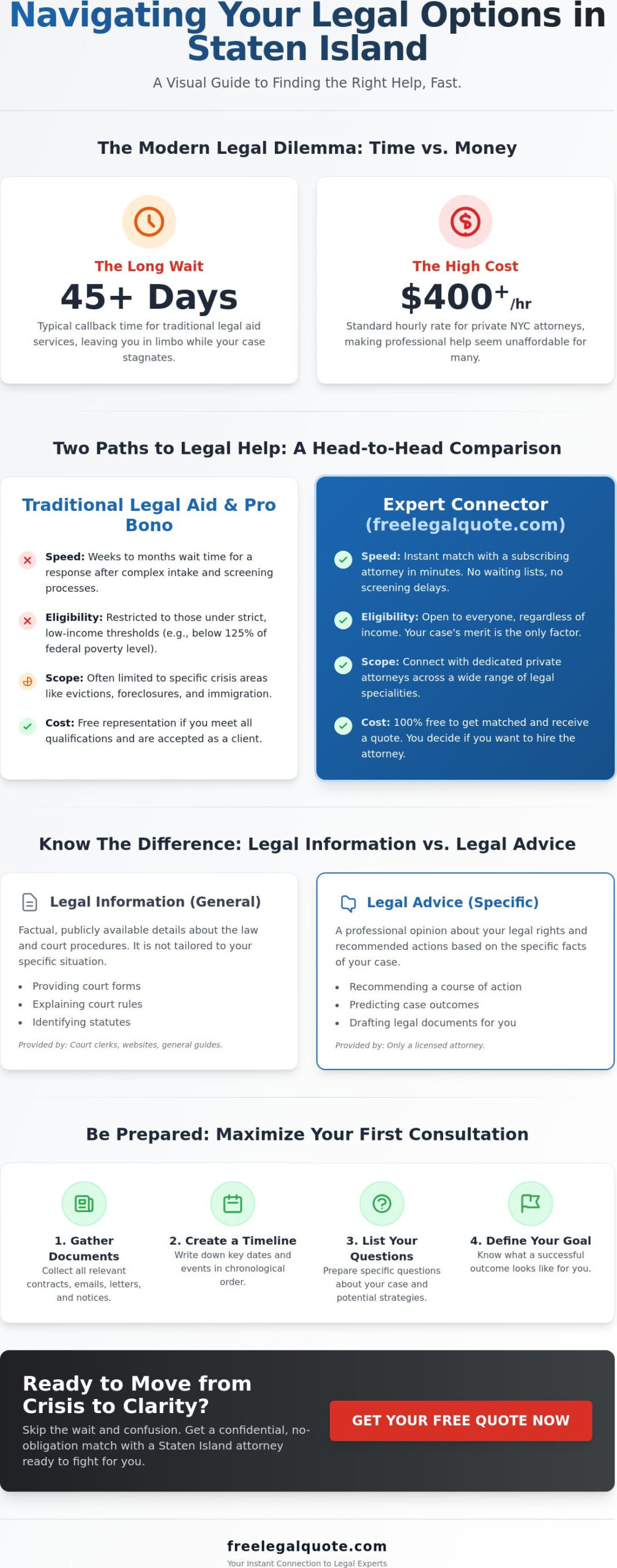
Comparing Pro Bono Help vs. Professional Legal Referrals
Securing the right advice in law often requires a choice between public assistance and private advocacy. In Staten Island, the “justice gap” affects thousands of residents who earn too much to qualify for legal aid but not enough to pay a $5,000 retainer upfront. Understanding the mechanics of these two systems is the first step toward resolving your legal crisis. Speed, scope, and eligibility are the three pillars that define your experience.
Speed of service is the most visible differentiator. New York City nonprofit legal providers are frequently overwhelmed. In recent reporting cycles, some civil legal service waitlists stretched beyond 150 days for non-emergency housing or family matters. If you are facing a court date next week, a nonprofit might not have the capacity to review your file in time. Private matching platforms function differently. They prioritize immediate connection, often linking you with a subscribing attorney within minutes to ensure no deadlines are missed.
The scope of representation also varies significantly. Many pro bono programs offer “limited scope” assistance. This might include a 30 minute consultation or help drafting a specific motion. However, they may not provide full-service litigation where an attorney stays on your case from filing to trial. Private referrals typically focus on comprehensive representation. You get a dedicated advocate who manages every filing, deposition, and court appearance.
The Pros and Cons of Pro Bono Services
Pro bono services are vital for the protection of civil rights and poverty law. The primary benefit is the zero-cost structure. These organizations specialize in issues like SNAP benefits, eviction defense, and domestic violence protections. However, the drawbacks are rigid. Most NYC programs use a 125% or 200% federal poverty guideline cap. For a single person in 2026, earning more than $32,000 annually could disqualify you from most free services. This leaves many hardworking Staten Islanders with no choice but to seek private counsel. Additionally, the high caseloads of public interest lawyers can lead to less frequent communication compared to a private firm.
The Advantage of Referral Platforms
Platforms like freelegalquote.com bridge the gap for those who need high-quality advice in law without the wait. We operate as an expert connector. Our system removes the guesswork by matching you with a professional who has the specific experience your case requires. We adhere to a “No Cost Ever” promise for the initial matching process. This allows you to explore your options without financial pressure or hidden fees.
If you are dealing with a specific crisis, such as a car accident or workplace harm, you need someone ready to fight hard immediately. You can view our best firm roundup to see which Staten Island professionals are currently accepting new contingency-based cases. This model is particularly effective because the attorney only gets paid if they recover money for you. It aligns your interests with theirs and provides a level of aggressive representation that pro bono clinics simply aren’t funded to provide.
You should consider switching from a public resource to a private advocate if:
- Your income exceeds the strict nonprofit eligibility caps.
- Your case involves complex litigation or high-value damages.
- You haven’t received a response from a legal aid clinic within 14 days.
- You need an attorney who can dedicate 100% of their focus to your specific trial strategy.
How to Prepare for Your First Legal Consultation in NYC
Your first meeting with an attorney is a high-stakes moment. It serves as the bridge between your current legal struggle and a concrete solution. To get the most effective advice in law, you must arrive organized and ready to act. This is not just about telling your story; it’s about providing the evidence that allows a professional to fight for you. Being prepared ensures that your consultation is productive rather than a simple introduction.
The Documentation Checklist
Organization is power. If you are dealing with a personal injury claim from an accident on the Staten Island Expressway, you need the police report and all 2026 medical records. For housing disputes in NYC, have your lease and every dated email sent to your landlord ready for review. Physical copies are helpful, but digital versions are often faster to process. Many modern firms now use AI intake tools to help you organize these files before the meeting. These tools categorize your evidence instantly, which allows your attorney to focus on strategy rather than paperwork.
- Personal Injury: Police reports, witness contact info, and hospital discharge papers.
- Housing Disputes: Lease agreements, rent ledgers, and violation notices from NYC HPD.
- Employment Law: Pay stubs, termination letters, and your employee handbook.
Writing a concise timeline of events is another essential step. Stick to the facts. List dates, times, and the names of everyone involved. This document helps you maximize your time with the lawyer. It prevents you from forgetting critical details when you feel under pressure. A clear timeline allows the attorney to identify the legal merits of your case in minutes.
Asking the Right Questions
Do not be a passive listener during your consultation. You need to know if the subscribing attorney is the right match for your specific case. You must determine if they have specific experience in Richmond County courts, as local procedural knowledge is vital for Staten Island residents. Ask these seven critical questions to gauge their expertise:
- How many cases have you handled in Richmond County courts?
- Who will be my primary point of contact during this case?
- What is your success rate with similar NYC litigation?
- Do you work on a contingency fee or require an upfront retainer?
- What are the potential risks or weaknesses of my case?
- How long do you expect this legal process to take?
- What is the very next step we take if I hire you?
Understanding the financial structure is vital for your peace of mind. A contingency fee means the lawyer only gets paid if you win. A retainer is an upfront payment used to cover their hourly rates. Always clarify this before signing any agreement. Everything you share during this initial match is 100% confidential. This creates a safe, no-obligation environment where you can seek the best advice in law without fear of a privacy breach.
Don’t wait to protect your rights. Get an instant match and a free legal quote today.
Instantly Connect with Staten Island Legal Experts
Finding reliable advice in law shouldn’t take weeks of research or dozens of unanswered phone calls. Freelegalquote.com operates as an expert connector, bridging the gap between your legal crisis and a qualified advocate in under five minutes. We’ve replaced the frustration of endless directory scrolling with a streamlined, pragmatic system designed for speed. Our platform focuses on moving you from a state of uncertainty to a direct conversation with a professional who understands your specific needs.
Every subscribing attorney within our network is selected based on their proven NYC expertise. We don’t use generic, national databases that ignore the specificities of New York statutes. Instead, we match you with local practitioners who handle litigation, probate, and personal injury cases every day. The process is 100% confidential and carries no obligation. You gain the clarity you need without the pressure of an immediate financial commitment or privacy concerns. It’s a secure, low-pressure environment built to empower the consumer.
- Instant Matches: Connect with a legal professional in minutes, not days.
- Vetted Professionals: Every subscribing attorney is deeply familiar with NYC court systems.
- Zero Risk: Our “No Cost Ever” referral guarantee ensures you never pay for the match itself.
- Total Privacy: Your information is protected and shared only with your potential advocate.
The Power of Local Advocacy
Staten Island operates within a unique legal ecosystem. A lawyer based in a different state or even a different part of the country won’t grasp the specific nuances of the Richmond County Supreme Court. You need an advocate who knows the local clerks, the specific judges, and the rhythm of the borough’s legal halls. These professionals are committed to fighting hard for the rights of New Yorkers. Efficiency is also rising. Many local offices now utilize Attorney AI Automations to manage administrative tasks. This shift allows your attorney to spend more time on your strategy and less on paperwork. In 2026, roughly 85% of high-performing local firms have adopted these technologies to stay responsive to client needs.
Your Next Steps: Get Matched Today
You can stop the legal overwhelm right now. Our three-step matching process is designed to be the fastest bridge to a solution. First, you provide the basic details of your situation. Second, our system identifies the right subscribing attorney for your specific case type. Third, you receive your match and start the conversation. We stand by our “No Cost Ever” promise for this referral service. You have nothing to lose by seeking professional advice in law today. Don’t let a legal deadline pass you by or allow a problem to grow. Start your solution and get the protection you deserve immediately.
Take Control of Your Staten Island Legal Strategy
The NYC legal landscape in 2026 moves fast. You now understand how to navigate the differences between pro bono resources and professional referrals. You’ve also learned that coming prepared to your first meeting protects your rights and saves precious time. Finding the right advice in law shouldn’t be a source of stress. Since 2010, our platform has acted as a high-speed bridge between Staten Island residents and the professional representation they need to move forward.
Don’t let complex court procedures in Richmond County overwhelm you. Our system is designed for speed and total privacy. It’s 100% confidential and there’s no cost ever to use our matching tool. We specialize in connecting you with dedicated subscribing attorneys who are ready to advocate for your interests. You’ve done the research; now it’s time for action. You deserve a legal partner who’s as committed to your case as you are.
Your solution is just a few clicks away. Let’s get started on your path to justice today.
Frequently Asked Questions
Is there such a thing as truly free legal advice in Staten Island?
Yes, you can access free legal help through organizations like Staten Island Legal Services or The Legal Aid Society. These groups provide advice in law for low income residents facing housing, debt, or family issues. The Legal Aid Society handles approximately 300,000 cases across the five boroughs each year. You should contact their Richmond Terrace office directly to see if your specific case qualifies for their current intake programs.
How do I know if I qualify for pro bono legal aid in NYC?
You qualify for pro bono aid if your household income falls below 200% of the Federal Poverty Guidelines. For a single individual in 2024, this threshold was exactly $30,120 per year. Organizations like the New York City Bar Association Justice Center use these specific financial markers to determine eligibility. You’ll need to provide your 2025 tax returns or recent pay stubs to verify your status during the screening process.
What is the difference between a lawyer and an attorney at law?
A lawyer is someone who graduated from law school, while an attorney at law is licensed to practice in court. In New York, an attorney must pass the Bar Exam and be admitted to the New York State Bar Association. This distinction matters because only a licensed attorney can sign legal documents or represent you in front of a judge. Always verify a professional’s status through the NYS Unified Court System’s database.
Can I get legal advice over the phone or 24/7 chat in New York?
You can get immediate guidance by calling the NYC 311 line or using the New York City Bar Association’s Legal Referral Service. Their phone lines operate during standard business hours, but roughly 65% of subscribing attorneys offer 24/7 digital chat options for initial inquiries. This allows you to get an instant match with a professional who can review your case details. Seeking advice in law through these digital tools saves time and provides a clear path forward.
What should I do if I am served with legal papers in NYC?
Act immediately because you typically have only 20 days to file a formal response if served in person. If the papers were delivered via substitute service, the New York Civil Practice Law and Rules gives you 30 days. Don’t ignore the summons. Contact a trusted professional to draft your Answer document. Failing to respond leads to a default judgment, which allows the petitioner to collect damages without your input or defense.
How much does a typical legal consultation cost in Staten Island?
A typical initial consultation through the New York City Bar Legal Referral Service costs exactly $35 for the first 30 minutes. Private firms in Staten Island may charge between $150 and $500 per hour depending on their experience level. Approximately 45% of private attorneys offer a no cost initial review to determine if they can take your case. Always ask for a written fee agreement before you commit to any long term representation.
Can a referral service like freelegalquote.com represent me in court?
Freelegalquote.com is a referral service that connects you with a professional subscribing attorney; it doesn’t provide direct legal representation. We act as a high speed bridge between your problem and a qualified solution. Once we match you with a dedicated professional, that individual or their firm will handle your court appearances and filings. Our role is to ensure you find the right help instantly without any obligation or initial cost.
How do I file a complaint against a New York attorney if I received bad advice?
You must file a written complaint with the Attorney Grievance Committee for the Second Judicial Department if the lawyer practices in Staten Island. This committee investigates claims of professional misconduct or unethical behavior. You can download the official complaint form from the New York Courts website. They processed over 2,000 inquiries in 2023 to maintain the integrity of the legal profession. Include copies of all relevant correspondence and fee agreements.